VueScan Review: A Legendary Scanner Utility at a Crossroads
2026 © Thomas Gade
Versions and Pricing
There are two editions available: VueScan Standard Edition and VueScan Professional Edition.For film scanning, only the VueScan Professional Edition is relevant. A single license works with all supported scanners. This is a major advantage over SilverFast, where each license is tied to a specific scanner model. In addition, a single VueScan license can be installed on up to four computers and used with any number of compatible scanners.
For many years, VueScan Professional cost less than US$100 and included lifetime updates. This exceptionally customer-friendly licensing model was one of the key reasons for the software's popularity.
New Customers: Updates for One Year Only
In 2021, Hamrick Software discontinued lifetime updates for new Professional Edition customers. Instead, updates are now included for one year, while the purchased version itself remains permanently usable.Subscription options with monthly or annual payments were also introduced.
Prices for VueScan Professional Edition:
June 2025: approximately US$200 as a one-time purchase or US$80 per year.
June 2026: approximately US$175 as a one-time purchase or US$70 per year.
Review
Anyone connecting an older scanner to a Windows 11 PC today should expect that the original drivers and software are no longer compatible. Manufacturers discontinued support for many of these devices years ago. Filling this gap is VueScan, a program that has earned an almost legendary reputation among scanner enthusiasts.No other application supports such a wide variety of scanners from so many different manufacturers. Whether on Windows, macOS, or Linux, VueScan has enabled countless scanners to remain in service long after their official software was abandoned. However, this extraordinary compatibility is only one part of its success.
Freedom to use older or newer versions
As a long-time VueScan user, I have found that new releases occasionally introduced problems. Features or functions that had previously worked flawlessly would suddenly become unreliable. In most cases, this affected individual scanner models. Fortunately, this was rarely a serious issue because it was always possible to reinstall an older version. From time to time, after several updates, I would check whether a bug or another temporary issue had been fixed and then switch back to the latest release.The flexibility offered by the original licensing model - the ability to install older versions whenever they were better suited to a particular project - has always been one of VueScan's greatest strengths. For example, I still own a laptop running Windows XP with a PCMCIA slot for a very old SCSI adapter dating back to around 1995. Adaptec never released a 64-bit driver for that adapter, which is why Windows XP remains the ideal operating system for this setup.
I use this laptop with both a Nikon LS-2000 film scanner and an Agfa flatbed scanner. It runs the 32-bit version of VueScan 9.3.22 and it works flawlessly.
No longer an option for new customers?
If I understand the current (2026) licensing terms correctly, new customers no longer have this flexibility. They must use a version that was released during the period covered by their license.Recommendations based on the previous licensing model
Many long-time users have not yet noticed this change. They continue to receive updates and therefore recommend VueScan based on their experience with the former licensing model. New customers, however, will never have that same experience and therefore will not recommend VueScan for the same reasons.The current licensing strategy is risky at a time when classic film scanners are steadily losing importance. Epson discontinued production of its film scanners in 2025. Anyone looking for a model such as the Perfection V850 Photo today must turn to the used market. Older models, such as the Perfection 3200, 4870 and 4990, can often be found for around US$50 to US$100. However, the accompanying Epson Scan software no longer runs under Windows 11. Someone who purchases a used Epson Perfection 3200 Photo at such a low price may reasonably wonder whether an additional software investment of around US$175 for the Professional Edition is still justified in relation to the price of the scanner. Some users will therefore be tempted to look for a copy on The Pirate Bay or simply reactivate an old PC running Windows XP or Windows 7.
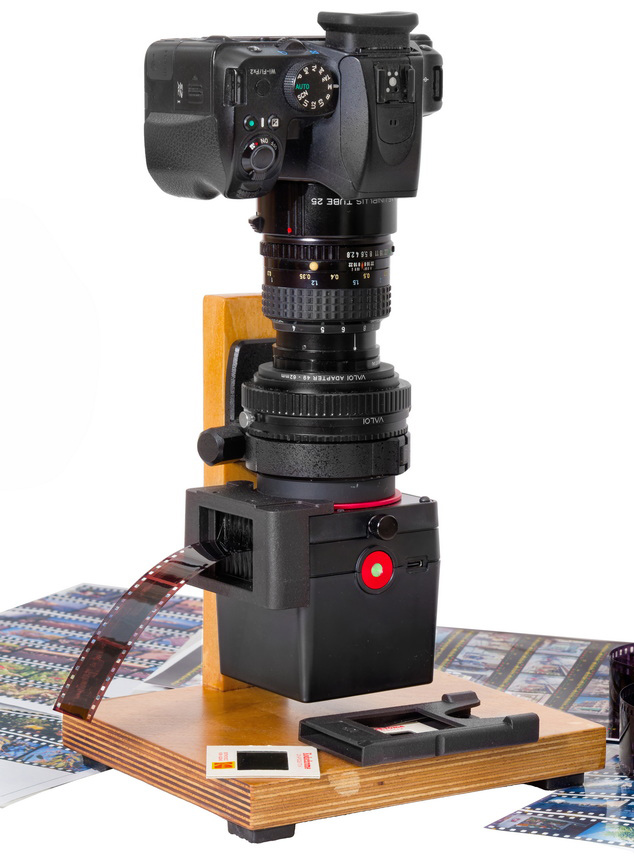
Scanning with a digital camera using the VALOI easy35 v2
At the same time, the traditional film scanner has lost much of its former uniqueness. Many film photographers now digitize their negatives using modern digital cameras. Products from Negative Supply, VALOI and other manufacturers have become increasingly popular for this purpose. This approach offers excellent speed and image quality, while software for converting negatives into positive images has become easier and more powerful than ever. Even smartphones can now be used to digitize film with dedicated apps.
Applications such as Capture One, ON1 Photo RAW and specialized solutions including Filmomat SmartConvert, Grain2Pixel, FilmLab, Negative Lab Pro and Negmaster demonstrate that digitizing film is no longer the exclusive domain of traditional scanning software.
Methods for removing dust and scratches, which currently still depend on the infrared channel of a film scanner, may soon be replaced by AI-based image processing.
This development is changing the role of software such as VueScan. Its greatest strength has always been controlling traditional scanners, but the importance of those devices is gradually declining as alternative digitization methods continue to improve.

From negative to positive with Grain2Pixel in Adobe Photoshop
For this reason, the development of an additional edition would be particularly compelling - one that combines traditional scanner workflows with camera-based film digitization. Such a solution should allow cameras to be controlled directly from the computer (tethered shooting) while integrating the proven tools of the Professional Edition. Especially important would be reliable automatic detection and removal of dust and scratches without requiring an infrared channel, as well as automatic detection and cropping of film frames.
For many existing VueScan users, such an expansion would be a strong incentive to purchase another license. The decisive factor, however, would be this: the original promise of long-term updates should be restored for this new edition. New customers could also be attracted through partnerships with companies such as VALOI, Filmomat, or Negative Supply, allowing both the hardware manufacturers and VueScan to promote one another.
Is that too much to ask? Hamrick Software is not a large corporation with hundreds of employees and substantial overhead. VueScan is developed by a small family-run company consisting of Ed Hamrick and his son David Hamrick.
In an online discussion in 2011, Ed Hamrick himself mentioned annual revenue from VueScan licenses of around US$3 million. In 2020, the VueScan website reported 600,000 users worldwide. Based on those figures, the Hamrick family is clearly running a financially successful business.
This is precisely why the short update period - which is evidently not the result of financial necessity - has disappointed many long-time users. From a brand management perspective, it is an unfortunate decision. Unlimited updates were one of the defining characteristics that made VueScan so successful for decades and generated exceptionally effective word-of-mouth recommendations.
Justification for paid updates
VueScan is a mature piece of software. This naturally raises the question of how paid updates can be justified in the future. Renewing updates and support for another year for the Professional Edition currently costs around US$70.Recent features
In October 2024, automatic colorization of black-and-white images was introduced. In November 2025, Super Resolution image upscaling followed. Both features require additional AI data packages, making what was once a remarkably lightweight application considerably larger.In March 2026, "Touch-Up" was added - a repair brush with content-aware retouching for scratches, dust, spots and other imperfections. While these additions are certainly useful, they also raise an important question: Is a scanning application really the right place for this type of image editing?
Future development should focus on the areas where VueScan can offer the greatest value. Camera-based film digitization, in particular, still offers enormous potential. As more photographers replace dedicated film scanners with modern digital cameras, this workflow is likely to become increasingly important.
VueScan has always excelled at controlling scanners. If future versions were to combine that expertise with a modern camera-based workflow - including tethered shooting, intelligent automatic film detection and AI-powered dust and scratch removal - it could once again become the leading solution for film digitization, regardless of whether the simage source is a scanner or a camera.
VueScan Professional: Still the best choice for film scanning?
VueScan remains one of the finest scanning applications available and supports an unmatched range of scanners. However, due to its current pricing and licensing policy, as well as modern alternatives to traditional film scanners, VueScan can no longer be recommended as unreservedly as it once was.Table of Contents:
General
IntroductionCalibration
Scanning black-and-white film
Scanning color negatives
Scanning slides
Identifying film types
Tabs
SourceCrop
Filter
Color
Output
Settings