This website focuses primarily on photographic technology. However, this is not a closed field – there are overlaps with other topics, for example optical instruments that are not photographic lenses but are primarily designed for visual observation. In addition to astronomical telescopes, which have their own large section here, one can also take photographs through microscopes, spotting scopes and sometimes even through binoculars. For a better overview, there are separate indexes and descriptions for various device categories.
Spotting Scopes

Telescope, Spotting Scope for terrestrial observations
Microscopes

Binoculars
BinocularsLeica Trinovid 8x20 BCA
Photography through Optical Devices
| Page: | 1. Optical Devices – Index |
| 2. Spotting Scope | 3. Microscope |
It is possible to take photographs through spotting scopes in order to use their strong telephoto performance. Smartphones are very well suited for so-called Digiscoping. They essentially look into the eyepiece of the spotting scope with the lens of their 1x zoom camera from the back, just as the human eye would. But system cameras can also be attached, and the solutions offered by optics manufacturers are not always the best.
There are various possibilities for macro and micro photography. Light microscopes have special lighting and stages for the subjects (specimens), which can be moved up and down, forward and backward, and from left to right using fine drives. Even if the microscope optics and the optical path to the recording medium are rarely ideal from a photographic point of view, microscopes offer possibilities that can hardly be realized in any other way. How they work and how best to adapt cameras to them is often puzzling for beginners. We describe the possibilities.

Smartphone on binoculars
Binoculars have two eyepieces and two objective lenses. Most magnify between 7x and 10x. Their objectives have apertures between 20 and 50 mm. There are also larger ones, but they are relatively rare. In practice, binoculars should be worn around the neck with a strap so that they are always ready to hand. They are usually held by hand. Therefore they must not be too large or too heavy. Binoculars can also be used as telephoto attachments for photography. In the past, analogue SLR cameras or the tiny Minox cameras were adapted to them. At present, only smartphones are reasonably sensible to combine with binoculars. They currently play no important role in photography, but if the opportunity arises, we will also deal with them.
Optical Adaptation
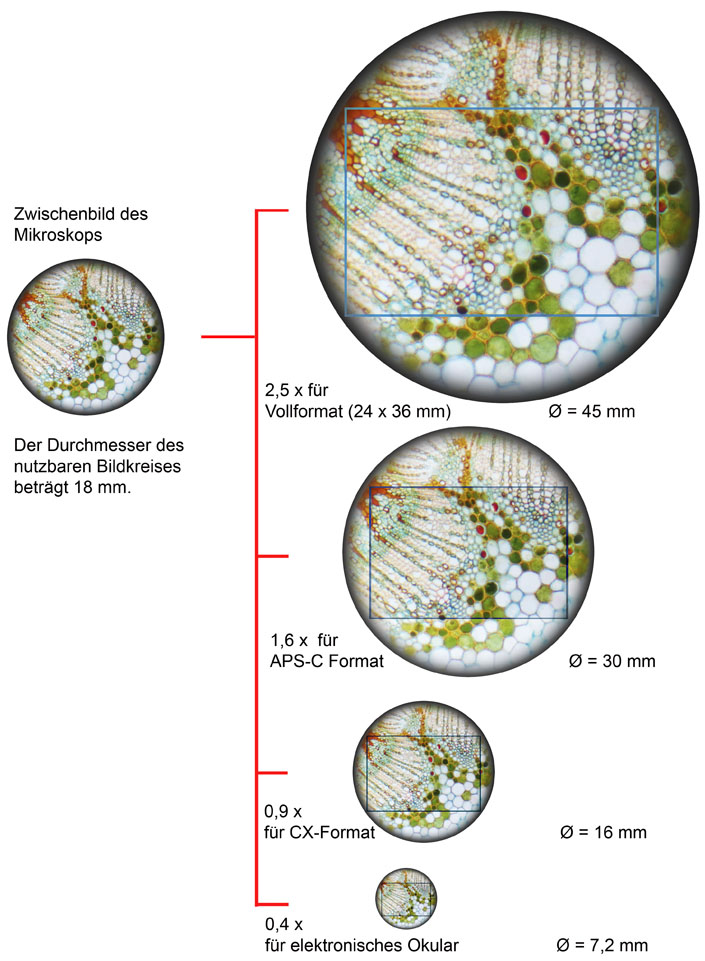
Lenses produce a round image – in optical instruments this is called the intermediate image, which is magnified by the eyepiece.
The diameter of the intermediate image corresponds to the image circle of photographic lenses. Standard eyepieces on microscopes use a circle of 18 mm diameter from the intermediate image. On the microscope this section is called the field of view.
For photographic purposes, the diameter of the usable intermediate image or the image from the eyepiece should be enlarged or reduced so that it matches the size of a sensor.
Optical elements are used to enlarge the usable image circle for large sensors and reduce it for small sensors. That is why the image is darker on large sensors than on small sensors. This aspect is important with regard to exposure times and autofocus usability.
continue reading ...
| Page: | 1. Optical Devices – Index |
| 2. Spotting Scope | 3. Microscope |
© Thomas Gade | photoinfos.com | ISSN 3054-4769 (Online). All texts and images are copyrighted. Any use requires written permission and is subject to a fee.