VALOI easy35 v2 Review
Digitizing Slides and Negatives with a Digital Camera2026 © Thomas Gade
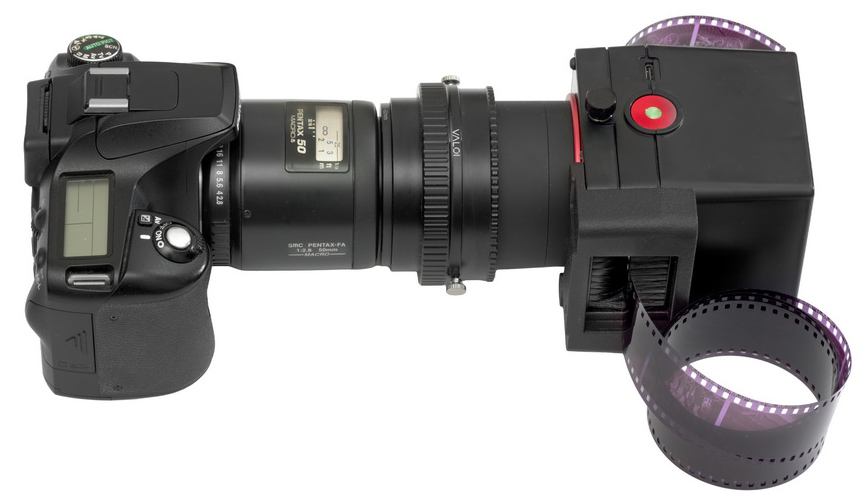
Traditional film scanners are relatively slow. A digital camera offers a much faster alternative, capturing each frame in a fraction of a second. With the right setup, advancing the film is just as quick. Converting negatives into positive images is no longer a challenge either. For example, Filmomat SmartConvert performs the conversion automatically as soon as new image files are placed in a monitored folder.
A typical camera scanning setup consists of a camera with a macro lens, an evenly illuminated light source, and a film holder. In most cases, these components are mounted on a copy stand to maintain the correct alignment and working distance.
With the easy35, VALOI takes a different approach. The concept is reminiscent of the slide duplicators made by Hama, Kaiser, Dörr, and Soligor decades ago. These devices screwed directly onto a lens's filter thread and featured a holder for slides or film strips as well as a diffuser, but required an external light source. In the simplest setup, daylight was all that was needed.
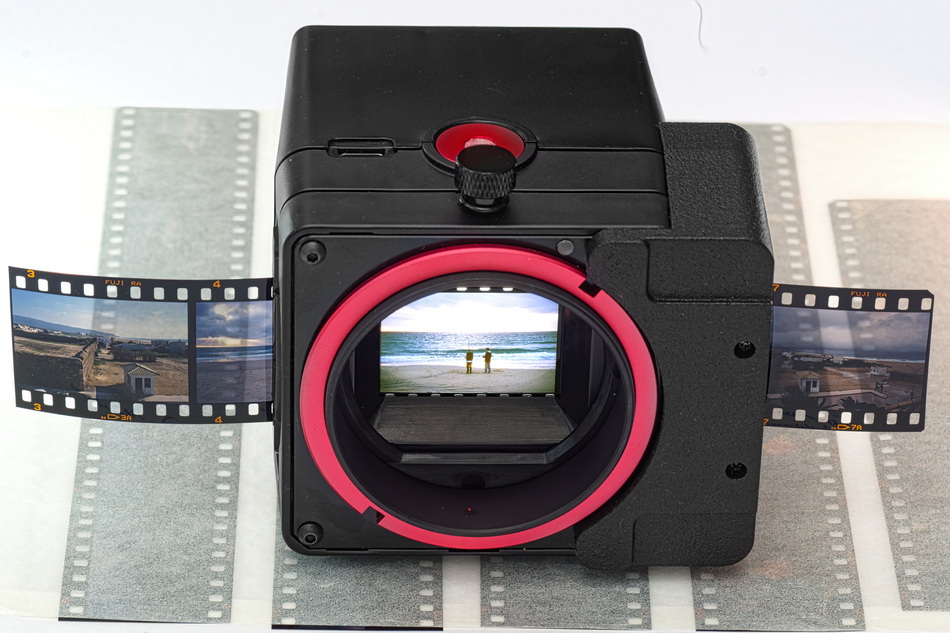
Main unit with integrated light source and film holder
Introduced in 2023, the original VALOI easy35 adopted the same basic idea but integrated a rechargeable LED light source directly into the film holder. As a result, there was no need for a copy stand. The compact system became an instant success and quickly established itself as one of the most popular solutions for modern camera scanning.
With the release of the VALOI easy35 v2 in 2026, the manufacturer has refined the concept in numerous ways. The original 3D-printed parts have been replaced by more precisely manufactured components. The most noticeable improvements are the metal threads and the metal locking mechanism used to secure the extension tubes. Also new is a magnetically attached anti-static dust brush. Overall, the second generation feels more robust and significantly better built.
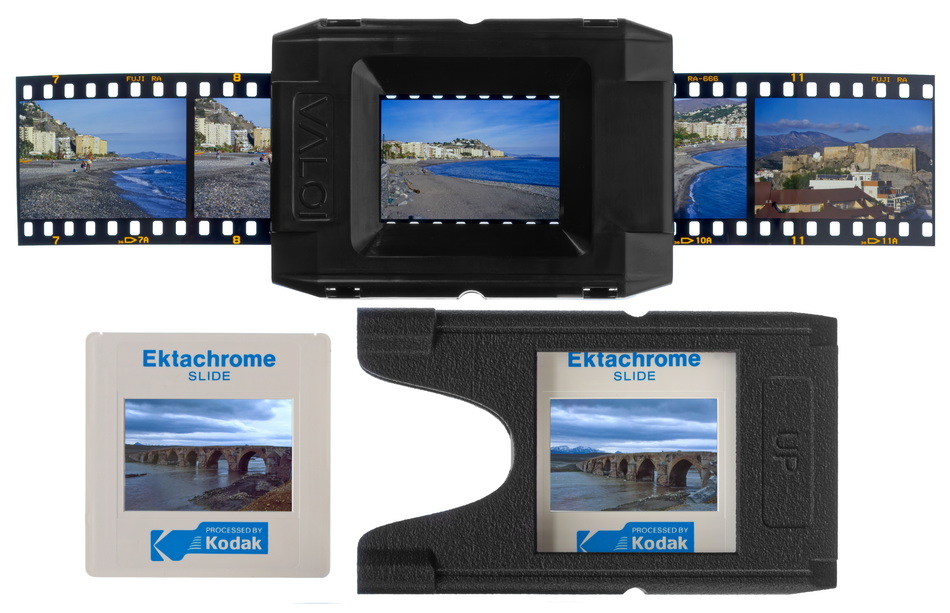
Film holders for film strips and mounted slides
The film holders have also been redesigned. They now slide into place and lock automatically, eliminating the clamping screw used on the previous model. The completely redesigned LED light source now provides approximately four hours of battery life instead of two. Alternatively, the unit can be powered continuously via USB-C using a power bank. This helps preserve the internal batteries while reducing heat buildup. According to the manufacturer, illumination uniformity has also improved from 81% on the original model to 99% on the second generation. Interestingly, the slight falloff toward the edges on the first version was not necessarily a disadvantage when scanning negatives, as it helped compensate for the natural vignetting of many camera lenses. This benefit does not apply when digitizing slides, however.
The VALOI easy35 v2 package includes the main unit with integrated LED illumination, a film holder for standard 35mm film strips, several extension tubes, filter thread adapters for various lens sizes, and a USB charging cable.
Film transport is smooth and effortless. Film strips slide easily through the holder while remaining well protected against scratches. VALOI also offers holders for additional film formats, including mounted slides, full-frame 35mm film with visible sprocket holes, APS, half-frame, and 110 film.
Helicoid for Precise Focusing Distance
The optional helicoid focusing unit is highly recommended. It allows the camera-to-film distance to be adjusted with great precision, making it easy to achieve perfect focus.DIY Support Stand
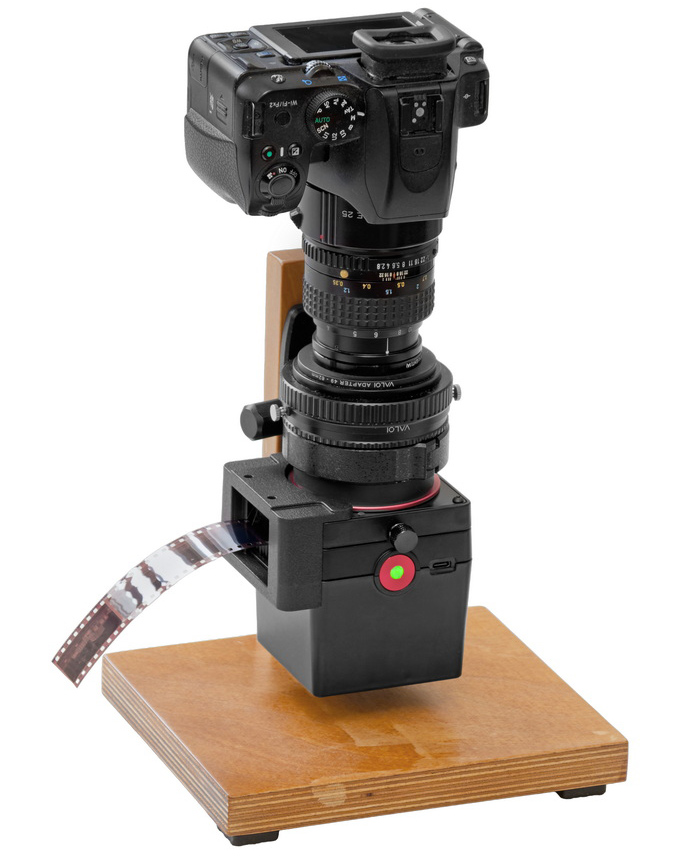
When in use, the VALOI easy35 v2 is typically placed on a tabletop together with the camera or simply held in the hand. This makes the system highly portable and easy to use almost anywhere. However, the entire assembly is supported by the lens's filter thread, so the lens should be sturdy enough to handle the additional load. My setup, consisting of an APS-C DSLR with a 50mm macro lens, the easy35 v2, extension tubes, and the helicoid, weighs approximately 590 grams (20.8 oz). Besides the weight itself, the leverage acting on the lens and camera mount should not be underestimated. Rugged manual macro lenses, especially older all-metal designs or affordable models from TTArtisan and 7Artisans, are therefore particularly well suited for this application.
Fortunately, there's an easy way to improve the setup. By attaching a 67mm tripod collar to a small homemade support stand, the entire assembly can be positioned upright on a table. This significantly reduces the stress on both the lens and the camera mount while leaving both hands free to operate the camera and advance the film. At the moment, however, VALOI does not offer such an accessory.
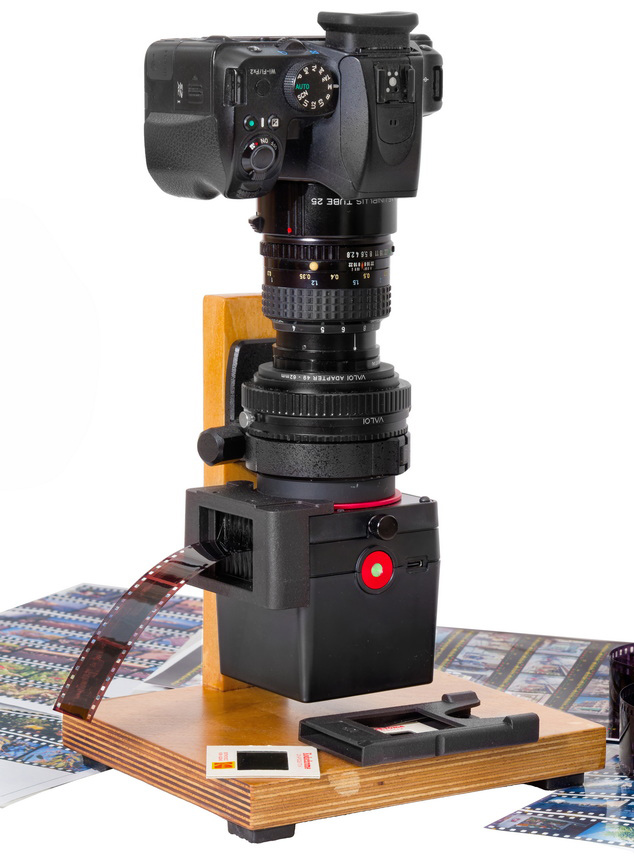
In my opinion, the VALOI easy35 (v2) is much more convenient to use with this support stand than without it. The helicoid also makes it incredibly easy to fine-tune the ideal distance between the lens and the negative or slide.
Lenses
To scan film with a digital camera, you'll need a lens that can focus close enough to fill the frame with the original. When scanning a 24 × 36 mm negative using a full-frame camera, this requires a 1:1 magnification ratio, which normally means using a true macro lens. Alternatively, extension tubes or close-up lenses can be used to reduce the minimum focusing distance of other lenses.The lens should also be robust enough to support the additional weight of the extension tubes and the VALOI easy35 without risking damage. Solidly built manual-focus macro lenses are the best choice. Autofocus lenses are recommended only if they use internal focusing.
For a more detailed discussion of suitable lenses, see my review of the original VALOI easy35.
Conclusion
The second-generation VALOI easy35 addresses many of the shortcomings of the original model and leaves a much more refined overall impression. It provides a fast and straightforward way to digitize 35mm film using a digital camera, without requiring a large copy stand or a separate light source. Personally, I consider the helicoid a much more worthwhile accessory than the optional anti-static dust brush. Dust can be removed very effectively with inexpensive disposable dusting cloths available at most drugstores, without generating static on the film. If you plan to digitize mounted slides, I would also recommend ordering the appropriate slide holder at the same time.Specifications
ManufacturerKameratori Oy, Finland
Model
VALOI easy35 v2
Compatible Film Formats
35mm film strips, mounted 2 × 2 inch slides, image size up to 40 × 40 mm
Weight
easy35 v2: 220 g
easy35 v2 with Slide Holder: 235 g
Prices (2026)
VALOI easy35 v2*: €229
Duster: €45
Slide Holder: €45
Sprocket Holder: €29
*Package contents: VALOI easy35 v2 main unit with integrated LED light source, standard 35mm film holder, extension tubes (1 × 10 mm, 1 × 20 mm, 5 × 40 mm; 230 mm total), plus thread adapters for 39 mm, 46 mm, 49 mm, 52 mm, 55 mm, 58 mm, and 67 mm to 62 mm. The extension tubes and the easy35 both use a 62 mm thread.
Converting Negatives
For many years, converting camera-scanned negatives into positive images—especially color negatives—was a task best left to experienced users with advanced image-editing skills. Today, however, a number of applications perform this process automatically. Popular options include Grain2Pixel, Negative Lab Pro, and FilmLab. We have covered several methods for converting negatives on dedicated pages, which are updated regularly as new software and workflows become available.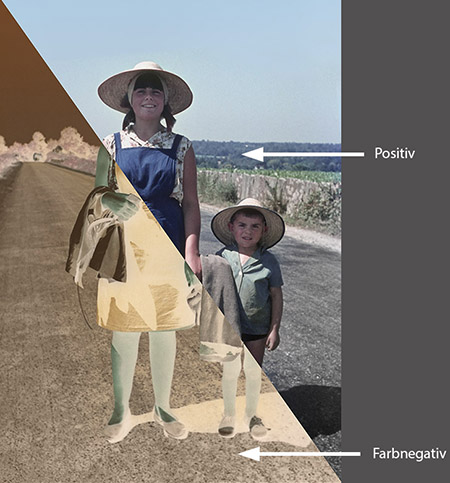
Converting Negatives to Positive Images
© Thomas Gade | photoinfos.com | ISSN 3054-4769 (Online). Unsere Texte und Bilder sind urheberrechtlich geschützt. Jede Nutzung ist nur mit schriftlicher Erlaubnis des Verfassers gestattet und stets honorarpflichtig.