VALOI easy35. Review
Scanning slides and negatives with a digital camera2024 © Thomas Gade
Scanning with a Digital Camera
Scanning with digital cameras is faster than with traditional film scanners - but only if the workflow and accessories are right. In theory, the setup is simple: camera body, macro lens, film, and a light source behind it. In most cases, a copy stand is used, as with the Valoi 360 System.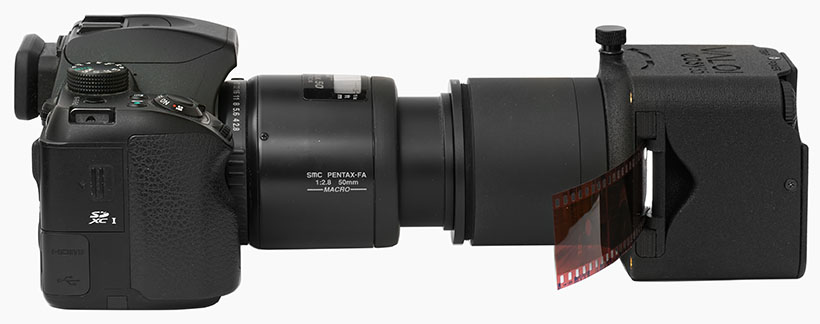
Pentax K-70 with smc Pentax-FA F2.8 50mm macro with Valoi easy35
Slide Copier
It also works without a copy stand. In the last century, Hama, Kaiser, Dörr, Soligor and others offered slide copiers that were screwed onto the filter thread of lenses. These were tubes with a holder for film strips or slides on one side. Behind them was a diffusion screen, but no active light source. Such devices are still available today, for example the Nikon ES-2 adapter or the Kaiser slide copier. Some models come with a removable close-up lens, so that special macro lenses are not required. The ideal focal length is about 100 mm (full-frame equivalent).Valoi easy35
Valoi produces a modern version with an integrated dimmable LED light that generates even, diffused illumination. Its CRI value is 95, roughly equivalent to visible daylight. The built-in battery lasts 2–3 hours and is charged via USB-C. Smartphone chargers are suitable, and a power bank can also be connected. Between the LED light and the film there is an additional plexiglass diffuser that is guaranteed not to yellow for 30 years.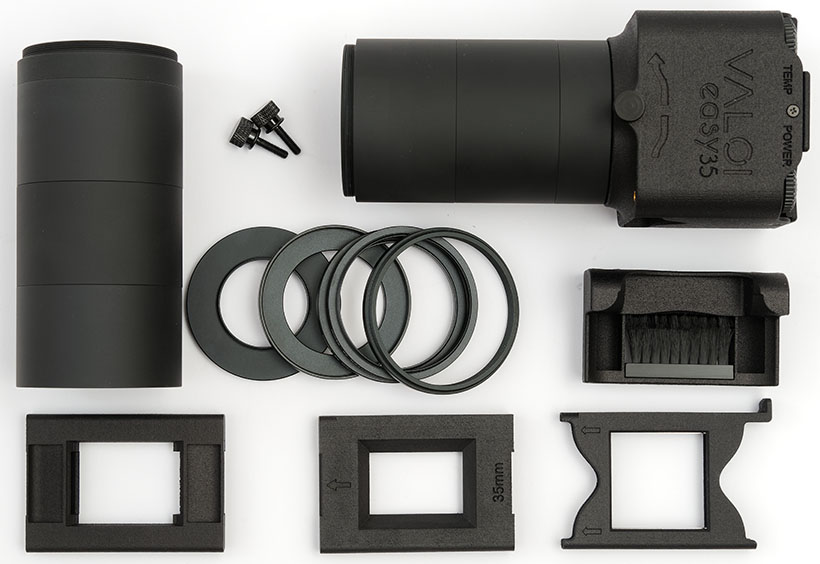
The Valoi easy35 includes several spacer rings, filter thread adapters, and a holder for 35 mm film strips. Additional holders are available, for example for mounted slides (50 × 50 mm) and for 35 mm film with a wider frame that includes the sprocket holes. There is also a double brush for dust removal—this is unnecessary.
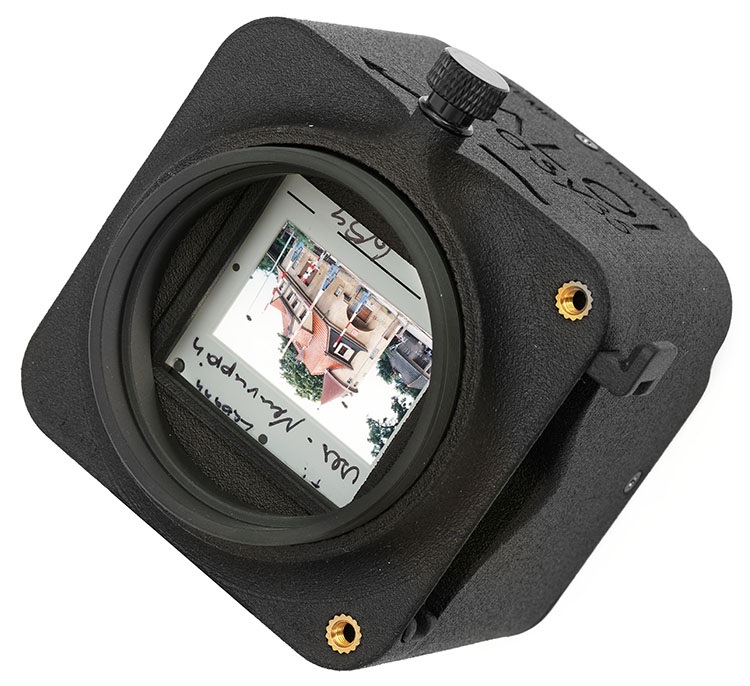
Base module of the Valoi easy35 with holder for a mounted slide, illuminated from the rear by a built-in LED light. The housing is 3D-printed.
Technical Specifications
ManufacturerKameratori Oy in Finland
Model
VALOI easy35
Supported formats
35 mm film strips, mounted slides 5×5 cm, image size up to 40×40 mm
Weight
easy35: 220 g
easy35 with slide holder: 235 g
Prices (2024)
Valoi easy35*: €229
Duster: €45
Slide holder: €45
Sprocket holder: €29
*Scope of delivery: VALOI easy35 module with LED light, standard 35 mm holder, spacer tubes: 1×10 mm, 1×20 mm, 5×40 mm (230 mm total), as well as thread adapters from 39 mm, 46 mm, 49 mm, 52 mm, 55 mm, 58 mm and 67 mm to 62 mm. The latter is the thread used on the spacer rings and the Valoi easy35.
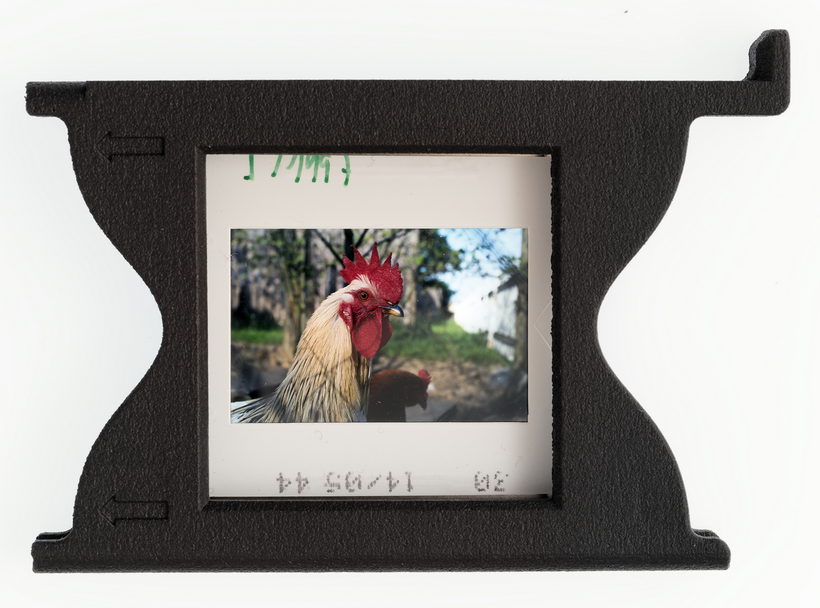
Holder for mounted slides (slide holder)
Slides are fed through one after another. This works well with mounts from 2 mm thickness; thinner mounts tend to jam because they overlap.

Sprocket holder (2025: €30). Holder for film strips with visible perforation. Is it worth it? Probably only rarely, as images including the film edge are seldom needed.
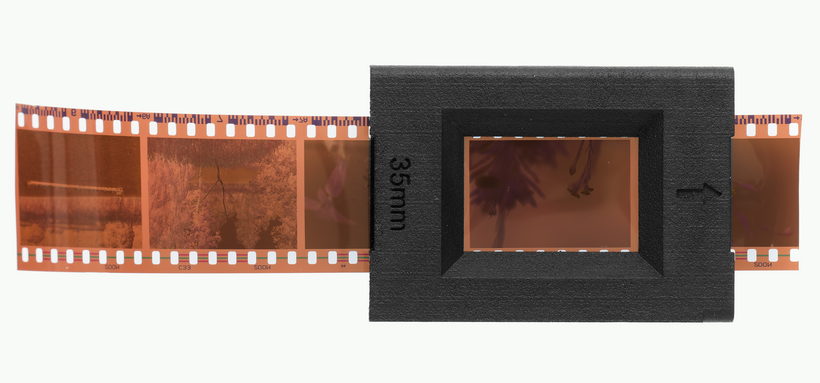
Holder for film strips
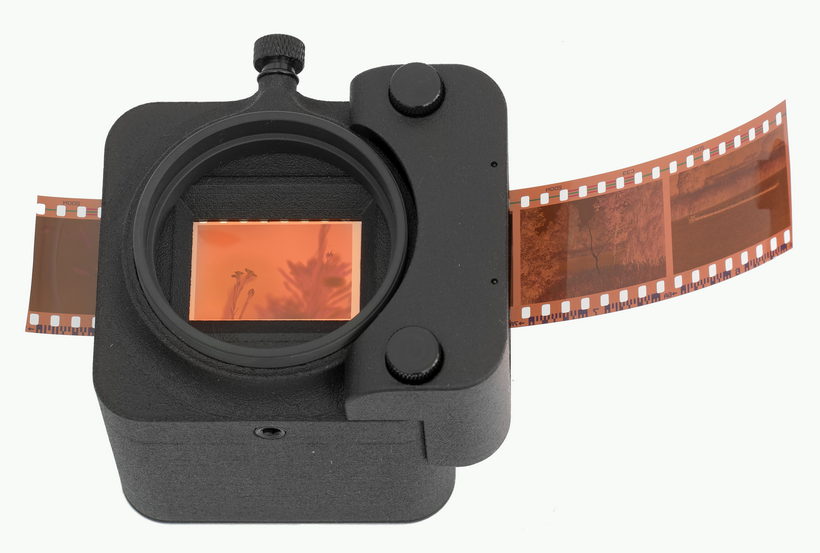
Valoi easy35 with attached dust brush
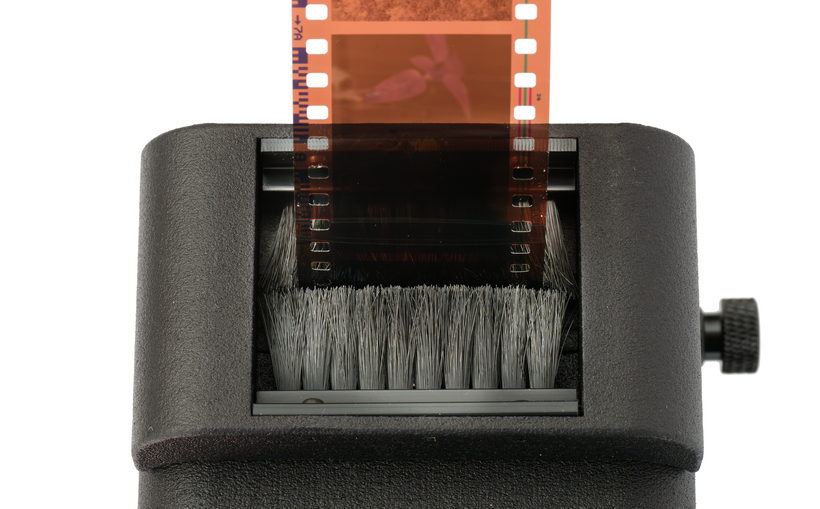
Brush on the Valoi easy35. The film strip is pulled between two brushes.
Lenses
For scanning with a camera, lenses must be able to focus close enough to fill the frame with the film. For scanning 24 × 36 mm on a full-frame sensor, this requires a 1:1 reproduction ratio, which without accessories can only be achieved with macro lenses. Alternatively, extension tubes or close-up lenses can be used to extend the close-focus capability of other lenses.They must be sturdy enough to avoid damage from the attached spacer rings and the Valoi easy35. Robust manual macro lenses are ideal. Autofocus is only recommended with internal focusing.
If focusing causes an inner barrel to extend, the mechanism must not be overloaded. However, it is unclear how much stress is safe, and no one wants to find the limit. Assume that good macro lenses can support ring flashes on the filter thread—but these sit directly on the lens, while the Valoi system adds a longer lever arm. Handling film strips or changing slides can place excessive strain on the lens.
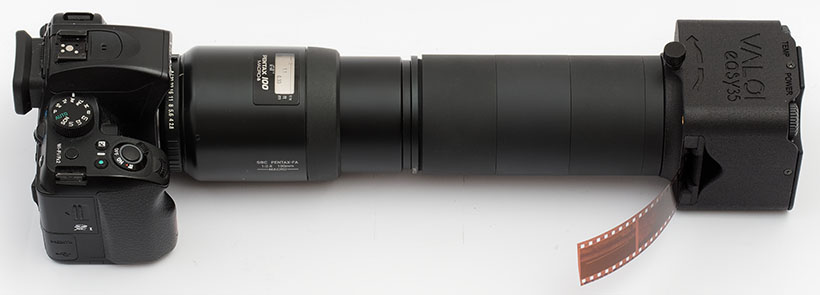
Pentax K-70 with smc Pentax FA 100 F4 Macro. The Valoi easy35 with spacer rings weighs 517 g. The concept is good, but sturdy lenses are required to withstand the leverage.
It is best to place the setup on a flat surface so the lens does not bear the weight. A smooth surface is important because lens length changes during focusing.

Pentax K-70 with Tamron 90mm F2.8 and Valoi easy35. The setup is long.
The many spacer rings suggest that long extensions are possible—but the total weight and leverage increase significantly. Remember: leverage multiplies force. Do not use this setup handheld—place it on a table.
Valoi recommends suitable lenses on its website.
Whether the Valoi easy35 can be used safely depends on the lens strength and keeping the distance between lens and module as short as possible.
Based on user feedback, lenses such as the Nikon Nikkor 55/2.8, Leica Elmarit 28mm (with extension tubes), and TTartisan 40mm Macro perform well due to their robust metal construction.
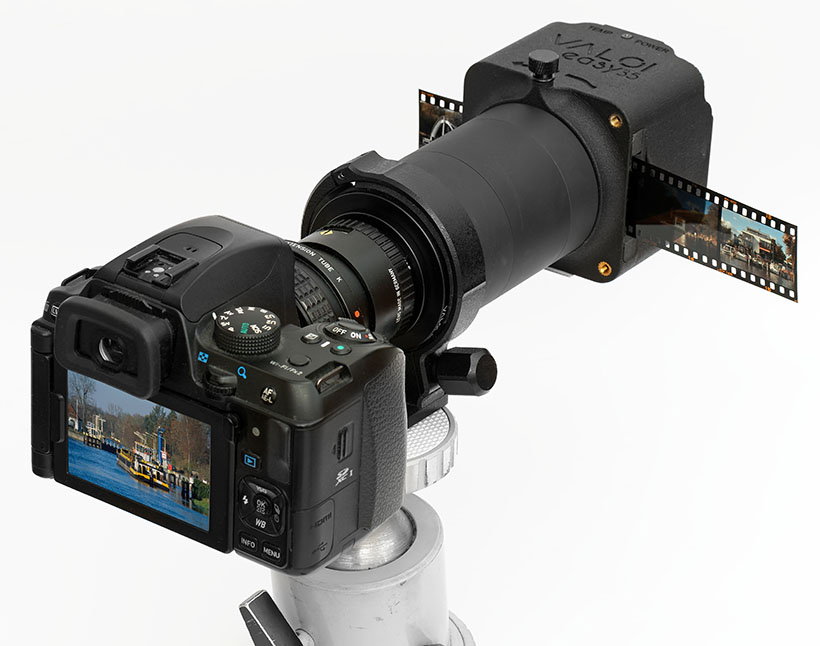
Pentax K-70 with focusing helicoid and Rodenstock Rodagon 60mm on Valoi easy35
A tripod collar (not included) can be attached to a spacer ring to stabilize the setup and reduce stress on the lens.
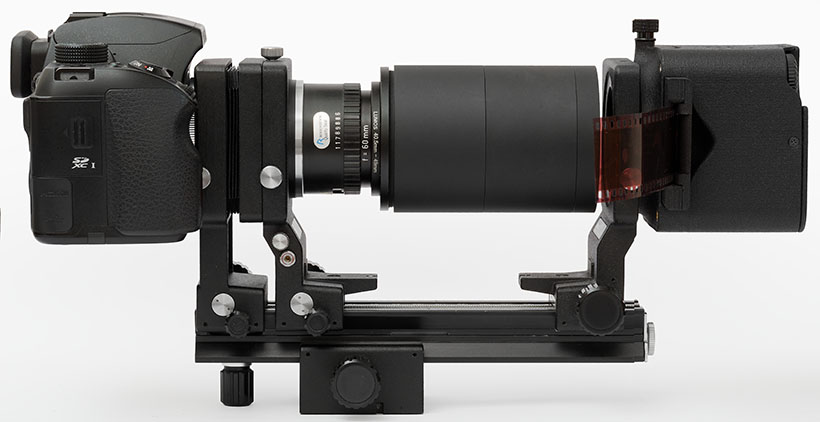
Using a bellows system can further reduce stress on the lens by mechanically separating components.
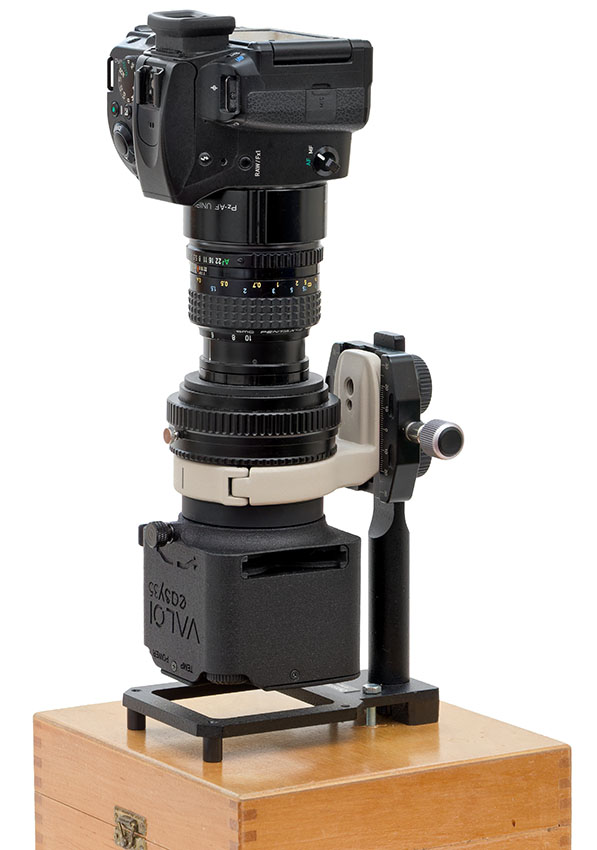
Ideal setup: mounted on a small copy stand with quick-release system—minimizes strain and allows hands-free operation.
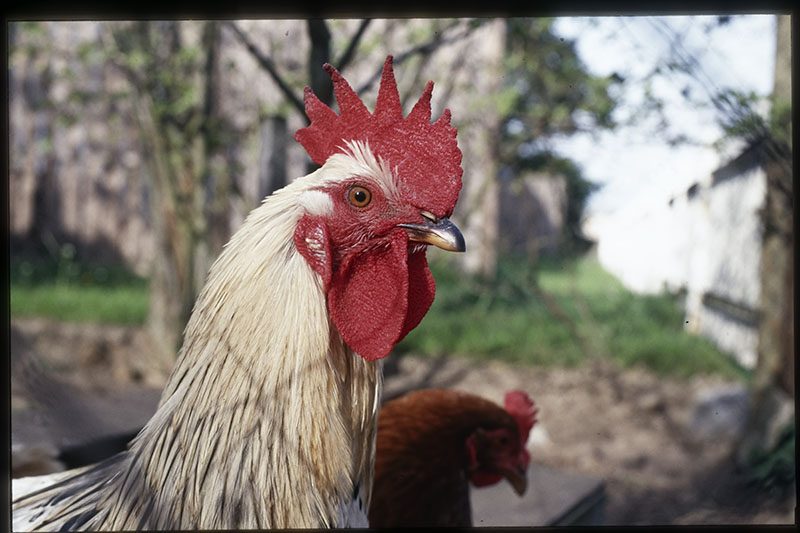
35 mm slide photographed with Pentax K-70 and Tamron 90mm macro lens
Cameras
Almost all digital system cameras from the past 10 years are suitable for digitizing film.APS-C sensors offer the best balance of aspect ratio, depth of field, and macro requirements for 35 mm film.
Pentax DSLRs with Pixel Shift are particularly recommended for improved color accuracy and detail resolution.
Practical Use
Once a good setup is found, scanning film strips is fast and efficient. Cotton gloves are recommended.Handling mounted slides is more difficult due to varying frame thicknesses and shapes.
Converting Negatives
Converting negatives used to require expertise, but modern apps like Grain2Pixel, Negative Lab Pro, or FilmLab now automate the process.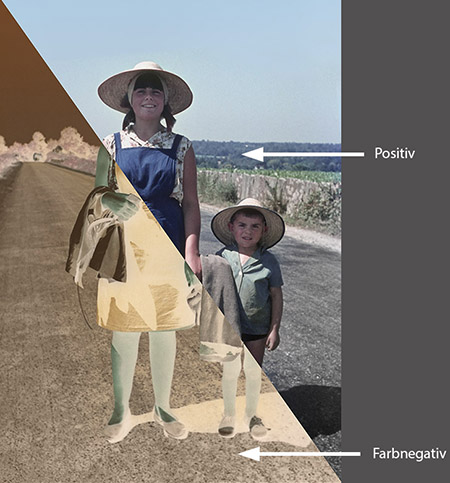
Convert negatives to positives