VALOI easy120. Review
Scanning slides and negatives with a digital camera2025 © Thomas Gade
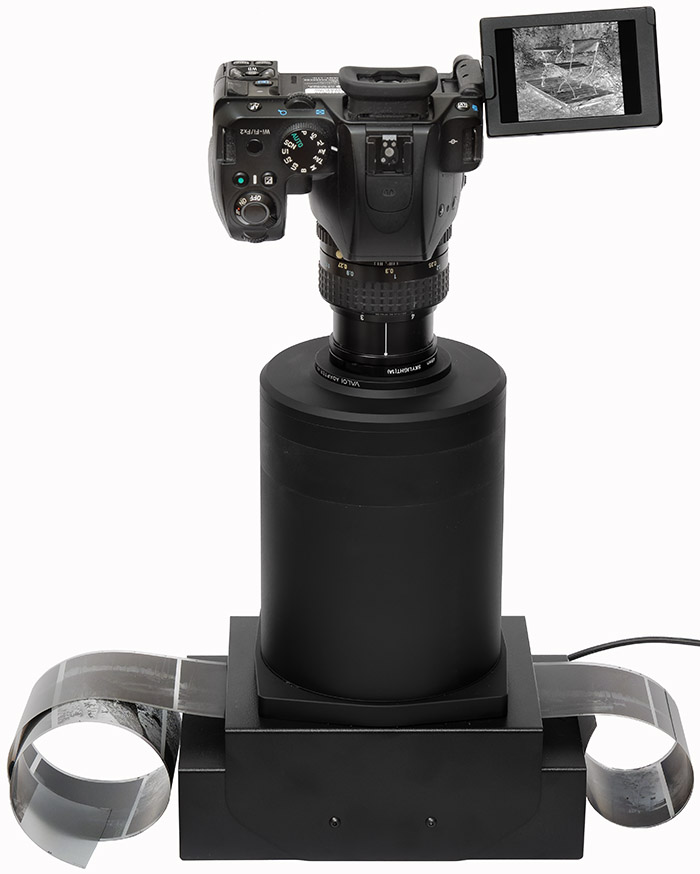
Valoi easy120 with Pentax K-70 and smc Pentax-A 2.8 / 50mm macro.
Scanning with a Digital Camera
To photograph slides and negatives, additional equipment is required. This usually includes a copy stand. Alignment must be precise: the sensor and the film must be parallel, and the optical axis of the lens should be perpendicular to the center of the film.This process is easier with the VALOI easy35 and VALOI easy120 models from Kameratori Oy in Finland. A copy stand is not required—only the correct distance and focus need to be set. The camera is simply screwed directly onto the VALOI system via the filter thread of the lens. Both models include LED light panels with diffuse illumination. The easy35 uses an internal battery, while the easy120 is powered via USB using a power bank or smartphone charger.
Technical Specifications
ManufacturerKameratori Oy in Finland
Model
VALOI easy120
Supported formats
120 medium format film strips, up to 6×9 cm
Weight
easy120 base module: 740 g
easy120 for 6×6 with 12, 25 and 100 mm tubes and end piece: 1255 g
easy120 for 24×36 mm with 12, 25 mm and end piece: 963 g
Prices (2025)
Valoi easy120* including 6×9 holder: €549
system 360 / easy120 duster: €39
easy120 35 mm slide holder: €69
easy120 35 mm filmstrip holder: €75
easy120 medium format holders 6×4.5, 6×6, 6×7: €69 each
easy120 advancer: €99
*Scope of delivery:
- VALOI easy120 module with CineStill CS-Lite LED light and 6×9 holder
- Spacer tubes: 2×100 mm, 1×50 mm, 1×25 mm, end piece with 62 mm mount
- Thread adapters for 39 mm, 46 mm, 49 mm, 52 mm, 55 mm, 58 mm, 62 mm, 67 mm, 72 mm and 77 mm

VALOI easy35 next to VALOI easy120
When choosing a lens, it is important to select the correct focal length for the sensor format. It should not be too long to avoid building a long tube from multiple spacer rings. The longer the setup, the greater the leverage acting on the lens mount. For APS-C cameras, around 50 mm is ideal for the Valoi easy35.
The same focal length also works well on APS-C sensors with the later Valoi easy120 for both 35 mm and medium format. However, the easy120 is significantly larger and heavier. The combination of camera, lens, spacer rings, and base module is too large and heavy to hold in one hand while advancing the film. A horizontal setup on a table is generally not recommended due to mechanical stress on the lens.

For horizontal use, a support is included that attaches to the tripod mount of the camera.
The best setup is vertical, with the spacer tube pointing upward like a stovepipe and the camera mounted on top. If autofocus extends the inner barrel of the lens, the mechanism is not designed to lift the camera body. In a horizontal setup, focusing can push or pull the entire system, increasing stress.
Therefore, autofocus lenses without internal focusing are not recommended for use with the Valoi easy120. Robust manual macro lenses with fixed focal lengths are a better choice. For testing, I used an older smc Pentax-A 2.8/50mm macro lens, which is inexpensive and worked well.
For APS-C / DX cameras, the TTArtisan 40mm f/2.8 macro lens is a good option, available for various mounts at around €100. It is fully manual and produces good results. Potential mechanical damage would be less critical due to its low cost.
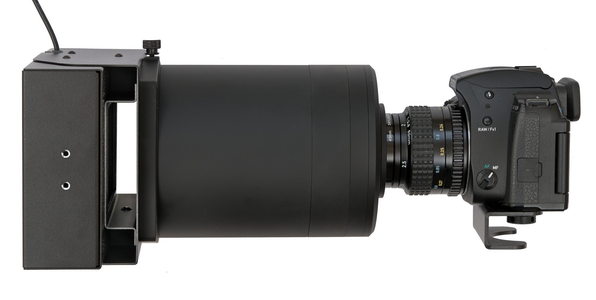
It is better not to place the Valoi easy120 like this on a table—the stress on the lens may be too high.
Film Holders
Various additional film holders are available. The '35 mm holder' for film strips is recommended.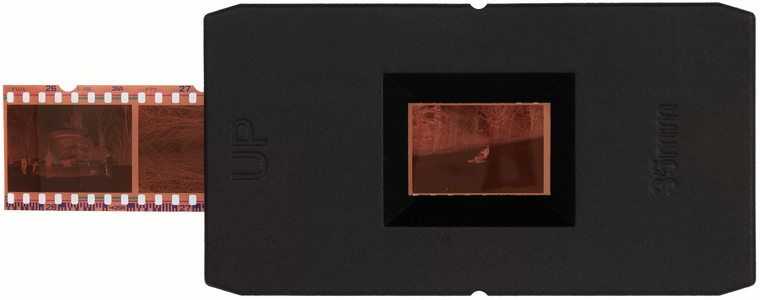
35 mm holder for film strips. At least four frames (24 × 36 mm) are required so that the strip protrudes and can be handled easily.
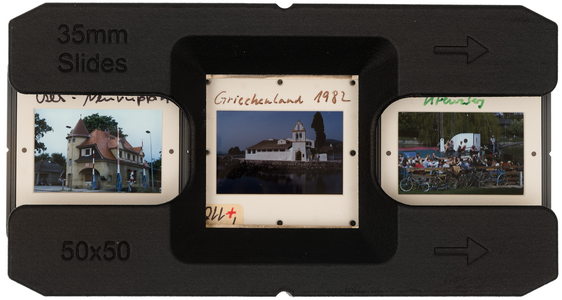
35 mm slide holder. Slide thickness can vary between 0.8 mm and 5 mm. Thin mounts may overlap instead of advancing properly, making operation difficult.
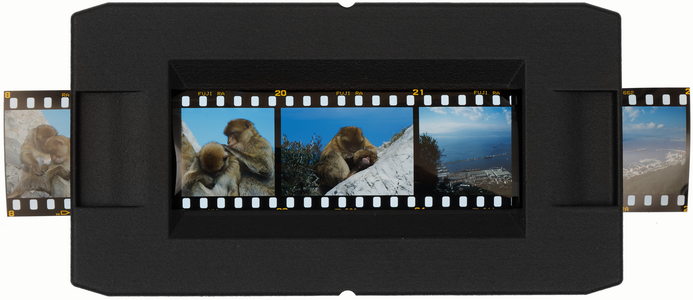
35 mm panoramic holder. The film edges remain visible but are not supported, resulting in poor flatness. A hinged holder with glass plates would be better. This design is not recommended.
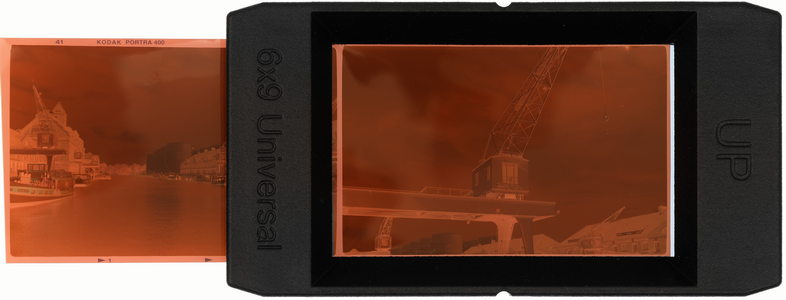
6×9 universal holder. Included with the easy120 and suitable for formats from 4.5×6 to 6×9. Film strips must be long enough to protrude for handling.

6×7 holder. In addition to the universal holder, dedicated holders are available for 6×4.5, 6×6, 6×7, and 6×9. Not all are required—6×6 film works well in a 6×7 holder. Light leaks can be prevented using black cardboard masks.
Additional Film Holders?
The holder slot offers potential for further development. Users with access to 3D printers can create their own solutions. Integrating holders from film scanners would be very useful—for example, those from Plustek OpticFilm scanners.The slot is also wide enough for mounted 6×6 slides, but no suitable holder exists.
Medium format films were often cut into single frames and mounted separately. These cannot be processed with the current holders.
35 mm Film Strips
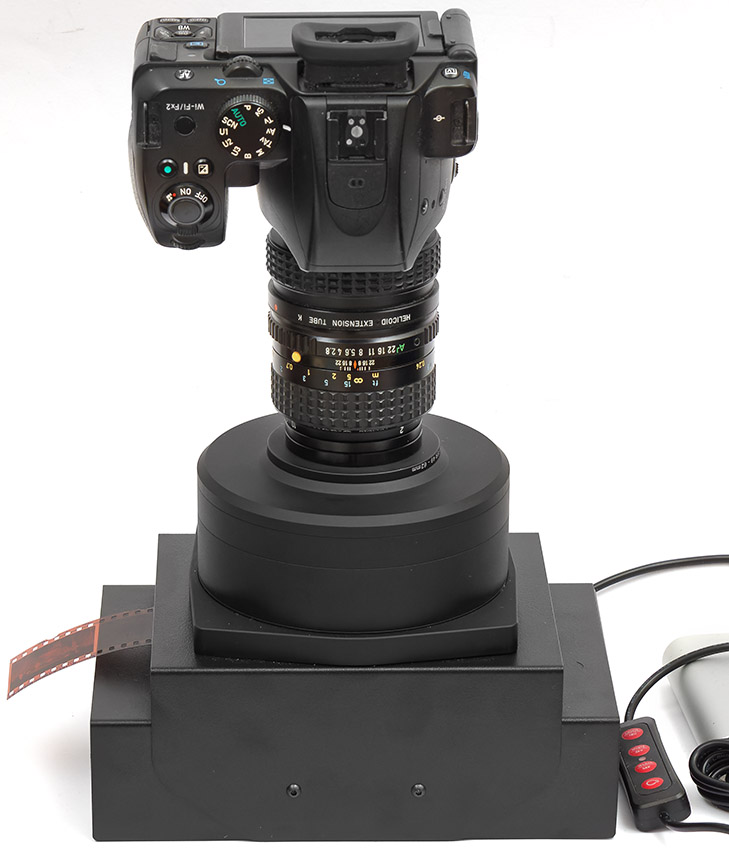
When scanning 35 mm film strips, the 12 mm and 25 mm spacer rings are sufficient for proper distance with a 50 mm macro lens on APS-C.
To fine-tune spacing, an additional spacer ring was improvised using a filter ring. A helicoid focusing adapter was added because the lens could not focus close enough.
Adjusting Distance with a Helicoid
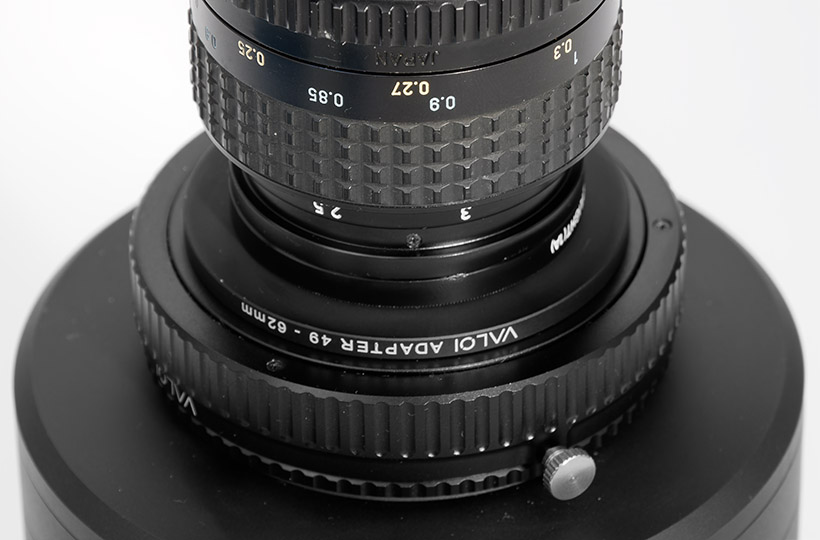
VALOI helicoid in collapsed position.
To allow fine adjustment beyond fixed spacer rings, the VALOI helicoid is available. It provides 20 mm of extension and mounts between lens and tube. It is not included and costs €79, but is a worthwhile investment.

Extended helicoid providing about 20 mm adjustment—sufficient for framing the image precisely.
Light Source
The built-in CineStill CS-Lite LED panel (9.5 × 15 cm) has a CRI of 95+ and provides even illumination. The distance to the film (~4 cm) helps avoid visible dust and improves light uniformity.Power is supplied via USB (e.g., power bank). Unlike the easy35, there is no internal battery.
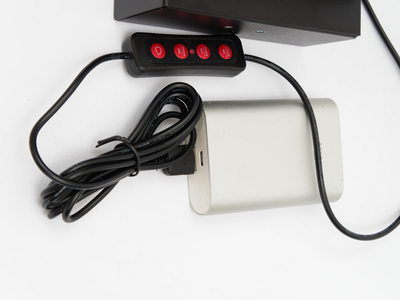
Power bank (not included) used to power the light.
Practical Use
Once properly set up, film strips can be digitized quickly. Ideally, scanning is done before cutting the film.Cotton gloves are recommended. Dust can be removed with soft dusters.
Evaluation
While the Valoi easy35 is very convenient, the easy120 is larger, heavier, and less user-friendly. The lack of an internal battery is a drawback.It is most useful for digitizing uncut 120 roll film.
Converting Negatives
Converting negatives used to require advanced skills, but modern software like Grain2Pixel, Negative Lab Pro, and FilmLab now automate the process.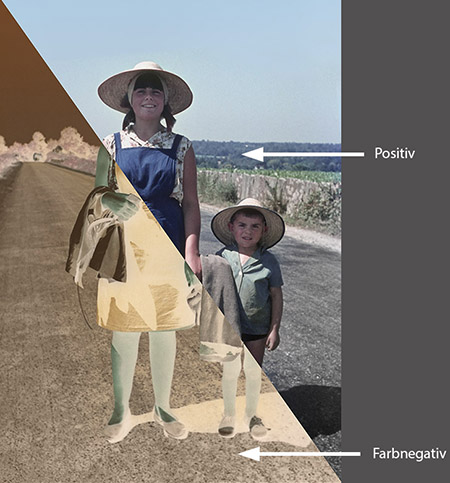
Convert negatives to positives