Sony RX10 Mark IV Bridge Camera: Image Quality at High ISO Settings
2019 © Thomas Gade| Index | 1. Zeiss Megazoom + Digital Zoom |
| 2. Autofocus, Shooting with a Tripod, Macro / Plant Photography | |
| 3. Power Supply, Exposure Times, Heat Haze, JPG or RAW? Wildlife Photography | |
| 4. Image Quality at Low and High ISO Settings, Evaluation / Photos from Berlin | |
| 5. Boat Photography |
ISO Settings and Image Quality
It is well known that modern APS-C and full-frame sensors can produce excellent images at four-digit ISO settings. How well can the smaller 1-inch sensor compete? A series of exposures from ISO 100 to ISO 12,800 demonstrates the changes in image quality. When comparing 100% views on a monitor, the differences become visible.
Test subject used to evaluate image quality changes at different ISO settings.
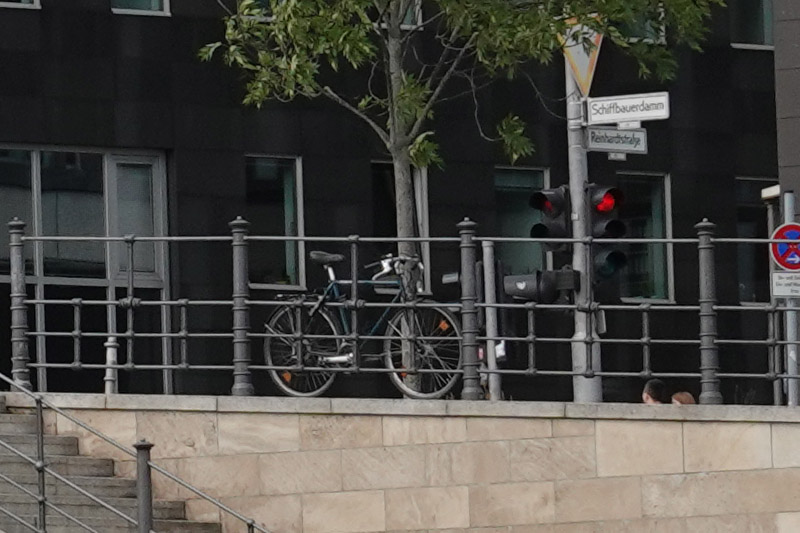
ISO 100. Crop (800 x 533 pixels) from the photograph.
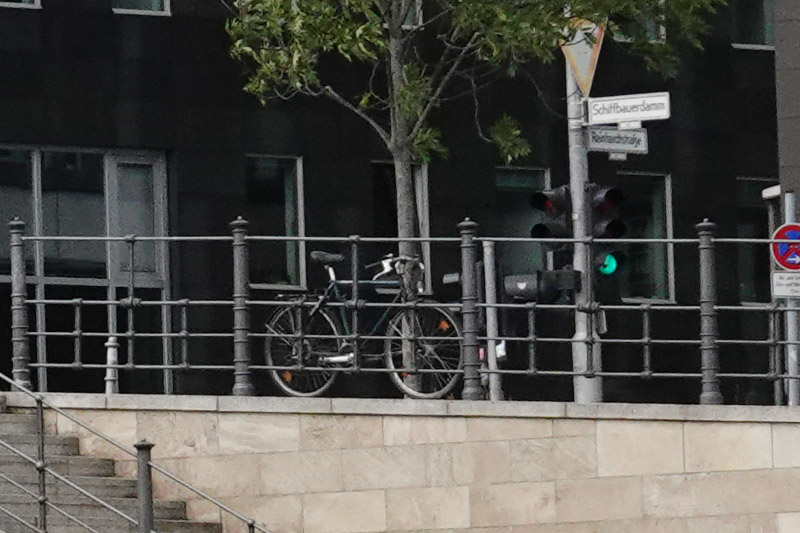
ISO 400. Crop (800 x 533 pixels) from the photograph.
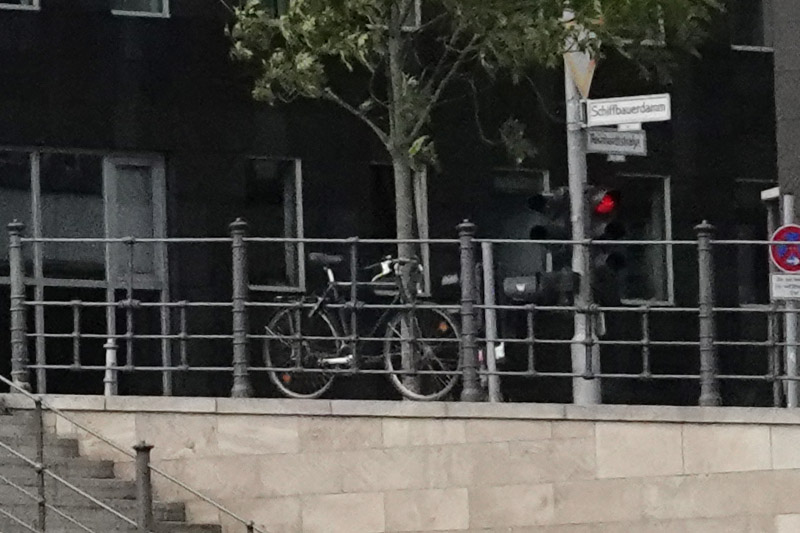
ISO 1600. Crop (800 x 533 pixels) from the photograph.
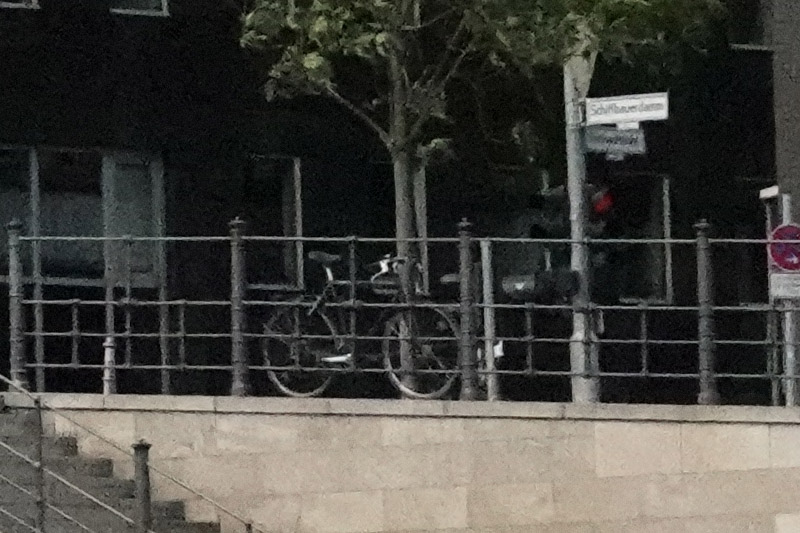
ISO 6400. Crop (800 x 533 pixels) from the photograph.
When looking closely at strongly enlarged image details, the gradual reduction in fine detail resolution at increasing ISO settings is clearly visible. As expected, micro-details are reproduced best at ISO 100. At ISO 1600, the decline in image quality becomes noticeable and is even more apparent at ISO 6400.
However, when viewing the complete image, the differences are far less dramatic. Pixel peeping is not the only way to evaluate photographs. Prints without cropping on A4 paper create a completely different impression. Even images taken at ISO 12,800 do not look nearly as poor as expected. Anyone who wants to print small, high-quality crops with plenty of detail should use ISO settings between 100 and 400. As ISO values increase, the available margin for attractive cropped images decreases.
This is an impressive achievement for a 1-inch sensor. Perhaps this was one reason why Nikon discontinued its otherwise unique Nikon 1 system, avoiding competition with its APS-C cameras.
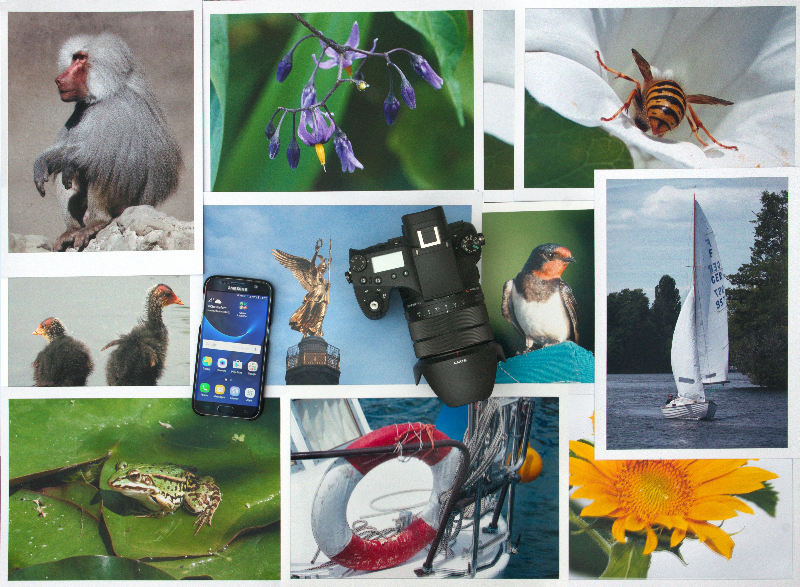
Ruthless pixel peeping by viewing heavily enlarged details can create dissatisfaction that is actually not justified. High-quality color prints on A4 paper often produce a much more pleasing impression.
Evaluation
Coming from a DSLR, operating the Sony RX10 IV initially feels unfamiliar. At first, photographers may tend to stop down the aperture more than necessary. In practice, it is better to let the camera's exposure automation choose the aperture and shutter speed. In daylight, ISO 100 or 200 is selected. In low light conditions, ISO can rise to 1600, and even higher values are usable with acceptable compromises.The camera generally prefers shooting wide open or stopping down by only one step. This is perfectly reasonable. The excellent lens, combined with the camera's internal image processing, produces sharp images. The touchscreen is often essential for selecting the correct focus point. In addition, the camera usually benefits from being mounted on a tripod because the powerful zoom lens encourages photography at long focal lengths. It is less often used for distant landscapes than, for example, for bringing a small frog approximately 2.5 meters away closer or photographing animals in a zoo.
Once you become familiar with the camera, the Sony RX10 IV is truly impressive. It is especially suitable for nature and wildlife photographers who need more reach than a 300 mm full-frame equivalent lens can provide.
Zoom lenses for APS-C DSLRs with comparable telephoto performance are large and expensive. The Canon EF 100-400mm f/4.5-5.6 costs around €2,000 and weighs 1.64 kg. The Nikon AF-S 80-400mm f/4.5-5.6 ED VR costs nearly €3,000 and weighs 1.57 kg. Both provide a 600 mm full-frame equivalent field of view on APS-C sensors. However, the lens of the Sony RX10 IV is one stop faster. A high-quality, fast 600 mm lens for a full-frame camera is considerably more expensive, larger and heavier. From this perspective, the Sony no longer seems expensive at all.
The additional lenses, larger camera bag and significantly higher weight required for a system camera setup are eliminated by the Sony RX10 IV thanks to its 25x zoom range. Anyone using it as a travel camera or for sightseeing should not leave the tripod at home simply for convenience. It can be the ideal compromise when image quality, zoom range and mobility all matter.
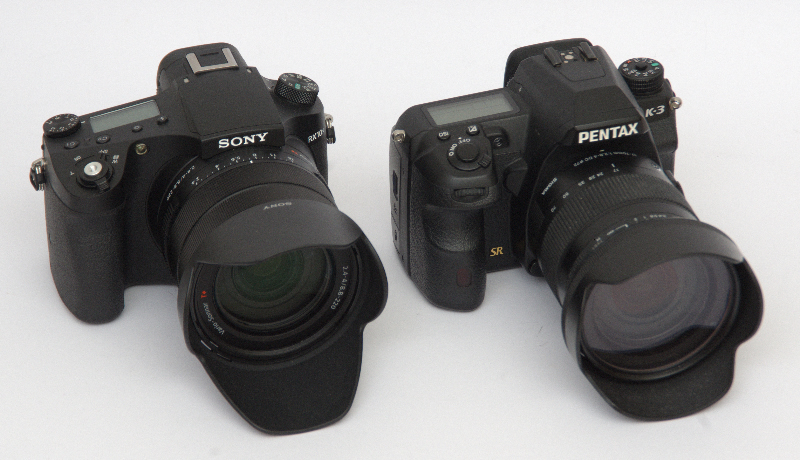
Sony RX10 IV bridge camera next to the Pentax K-3 DSLR with Sigma 17-70 mm lens. The cameras look similar externally, but the Sony has a smaller sensor and a superzoom lens with a wide focal length range, while the Pentax DSLR uses an APS-C sensor and interchangeable lenses.
Sample Images: Sightseeing in Berlin

Victoria, popularly known as "Goldelse", on top of the Victory Column.
Settings: f/6.3, ISO 400, 1/400 s, 64 mm (177 mm full-frame equivalent) focal length
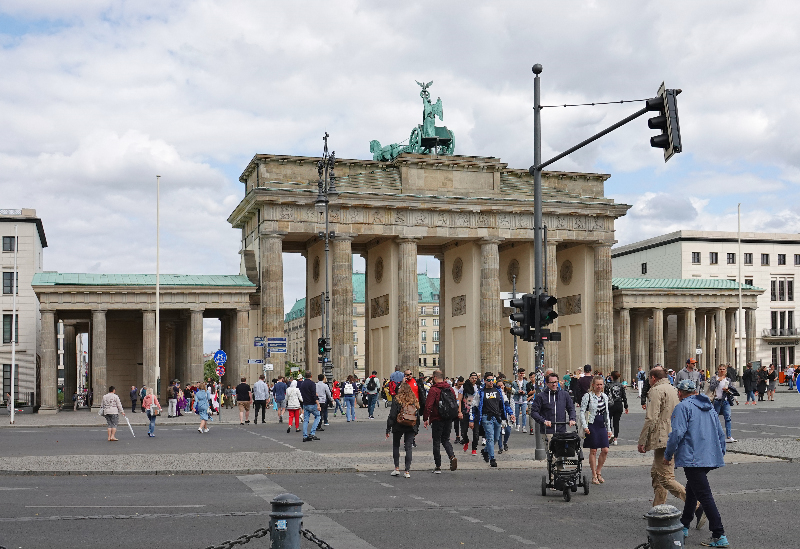
Berlin. Brandenburg Gate. Settings: f/4, ISO 100, 1/640 s, 13 mm (36 mm full-frame equivalent)

Berlin. Central Station. Settings: f/5.6, ISO 100, 1/250 s, 24 mm (65 mm full-frame equivalent)
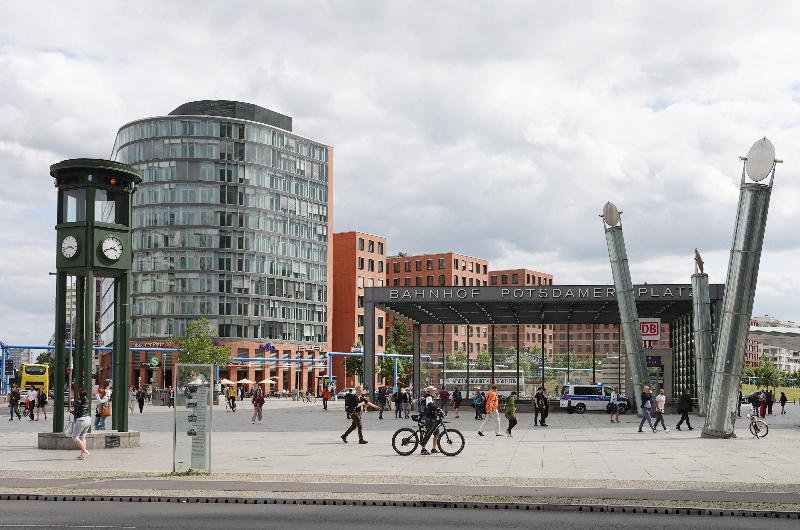
Berlin. Potsdamer Platz with traffic light tower. Settings: f/4, ISO 100, 1/800 s, 15 mm (40 mm full-frame equivalent)
Composing an Image from Multiple Photos

Berlin. Potsdamer Platz. Four individual images used for panorama stitching.

Berlin. Potsdamer Platz railway station. Panorama created by stitching six individual images with Kolor Autopano Giga.
| Index | 1. Zeiss Megazoom + Digital Zoom |
| 2. Autofocus, Shooting with a Tripod, Macro / Plant Photography | |
| 3. Power Supply, Exposure Times, Heat Haze, JPG or RAW? Wildlife Photography | |
| 4. Image Quality at Low and High ISO Settings, Evaluation / Photos from Berlin | |
| 5. Boat Photography |