Sony RX10 Mark IV Bridge Camera
2019 © Thomas Gade| Index | 1. Zeiss Megazoom + Digital Zoom |
| 2. Autofocus, Shooting with a Tripod, Macro / Plant Photography | |
| 3. Power Supply, Exposure Times, Flicker, JPEG or RAW? Wildlife Photography | |
| 4. Image Quality at Low and High ISO Settings, Evaluation / Photos from Berlin | |
| 5. Boat Photography |
Autofocus
The Sony RX10 IV features an electronic viewfinder and a tilting touchscreen for selecting the subject.When looking through the electronic viewfinder, the autofocus system automatically decides what to focus on. In many photographic situations with focal lengths between 24 and 200 mm, it performs this task flawlessly. However, this often fails at close distances when the scene contains elements at different distances from the camera. The camera then focuses on something, but only rarely on the desired subject. This increasingly becomes an issue outside close-up photography as well at focal lengths of 300 mm and above.
Sony should equip the next model with Canon's Eye Control technology, which detects where the photographer is looking and focuses on that point. Such an improvement would greatly enhance the camera.
Focusing with the Touchscreen
Focusing with the touchscreen is much more reliable. A simple tap on the desired subject is sufficient. This works handheld, but even better when the camera is mounted on a tripod.
A quick tap on the subject to be focused on ensures accurate focus. This is particularly important in close-up photography.
Autofocus with Face Detection
When photographing people, the camera detects faces and focuses on the eyes. This works impressively well during continuous shooting or video recording when people move in front of the camera. If a person walks toward the camera, the autofocus adjusts quickly enough to maintain a high hit rate. Here too, a tripod is advantageous because you can tap the desired face on the touchscreen. The camera then knows which person the autofocus should follow.Wide Aperture
The automatic exposure system tends to use the widest possible aperture. This is not a problem for the extremely sharp Zeiss lens. However, from about 110 mm (300 mm full-frame equivalent) onward, depth of field becomes very shallow, and an image will fail if the wrong part of the scene is in focus. Stopping down further is not the solution. Beyond f/8, diffraction reduces sharpness, which can noticeably affect image quality because of the very high pixel density on the relatively small sensor.For this reason, it makes sense that the camera generally prefers apertures of f/4 and f/5.6. In terms of depth of field, these correspond roughly to f/8 and f/11 on an APS-C camera at comparable focal lengths.
The larger aperture also allows lower ISO settings, which contribute significantly to the excellent image quality of the 1" sensor.
Shooting with a Tripod
For fast and reliable focusing, the camera is best mounted on a tripod. It then becomes easy to tap the correct point on the touchscreen, allowing the autofocus to lock on quickly and accurately. This results in many more sharp images than handheld shooting.I used the Sirui R-3213X tripod (1.8 kg) together with either a Sirui VH-10 Fluid Video Head (920 g) or the Sirui L-20S Panoramic Tilt Head (433 g). Both the tripod and the heads are designed for considerably heavier equipment than the relatively lightweight Sony RX10 Mark IV, providing an exceptionally stable platform. The panoramic head has only a short Arca-Swiss compatible clamp. Therefore, the camera should be fitted with a rail about 12 cm long so that it can be properly balanced when the zoom lens is fully extended. Otherwise, the camera may tilt forward after loosening the vertical clamp. The rail supplied with the Sirui VH-10 already provides sufficient adjustment range.

Sony RX10 IV mounted on a sturdy Sirui tripod. This is the setup in which the bridge camera performs at its best.
Depending on the tripod head used, the total weight of the camera and tripod ranges from 3.4 to 3.9 kg. Nature photographers who hike with their equipment will especially appreciate this. The overall weight is relatively low and well suited for outdoor photography.
Remote Release
When the camera is mounted on a tripod, using a remote shutter release is the logical choice. The Sony RX10 IV offers several options. Surprisingly, it even includes the classic threaded cable release socket, something few people would expect to find on a modern digital camera.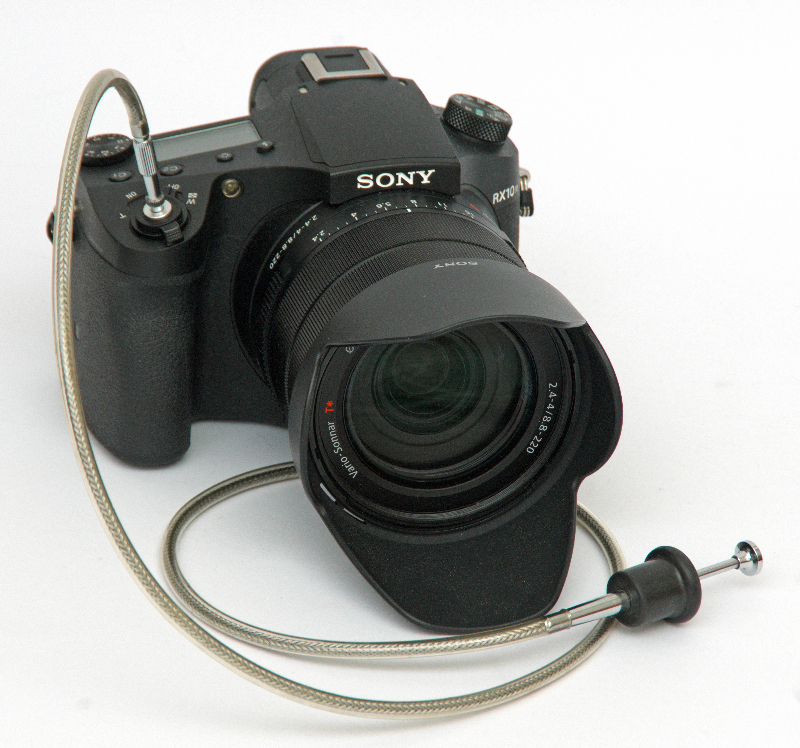
Numerous connectors. The Sony RX10 IV is even compatible with a traditional mechanical cable release.

Wireless shutter release is also possible, either with an optional radio/infrared remote or via a smartphone over Wi-Fi.
Viewing the Display in Bright Sunlight
The electronic viewfinder is very useful when sunlight makes the rear display difficult to see. However, the touchscreen is sometimes indispensable for precise focusing. Bright ambient light can therefore become a problem. The display brightness can be increased in the menu to compensate. When shading the display with your hand, however, the edge of your hand often passes in front of the electronic viewfinder. The camera then assumes that you are looking through the viewfinder and switches the display off.The best solution is a simple homemade accessory. Cut a small hood from black cardboard to shield the display from direct sunlight. Glue a plastic hot-shoe cover onto it so that it can be attached to the camera. When the camera is mounted on a tripod, this sunshade does not get in the way at all.

Homemade display hood made from black cardboard.
Macro Photography
At 24 mm, the shortest distance between the subject and the front lens element is about 3 cm. As the lens is zoomed toward the telephoto range, the minimum focusing distance increases. At the longest focal lengths, the subject must be at least 1.40 m away. During testing, it became apparent that objects photographed at the minimum focusing distance appear almost the same size regardless of focal length. In other words, moving very close with the wide-angle setting does not produce greater magnification than photographing from over one meter away with the lens fully zoomed.Handheld close-up photography of plants is almost impossible. The photographer's own body movement, together with movement of the plant caused by wind, exceeds the limits imposed by the very shallow depth of field. Motion blur can be reduced by using high ISO values and very short exposure times, but these measures cannot compensate for the constantly changing distance between the camera and the subject.

At 8.8 mm (24 mm full-frame equivalent), the minimum distance between the front lens element and the subject is only 3 cm. As the focal length increases, the minimum focusing distance becomes longer, but the magnification remains approximately the same throughout the entire zoom range of the Sony RX10 IV.
The success rate when photographing bees, butterflies, bumblebees on flowers, or dragonflies perched on reeds while shooting handheld is disappointing unless there is absolutely no wind. This is not a weakness of the Sony RX10 IV but a general challenge in outdoor macro photography. A tripod greatly increases the number of successful images because it eliminates the photographer's own movements, which occur even in calm weather. Unfortunately, insects rarely wait while photographers set up their equipment. Ideally, the camera should already be mounted on a tripod in front of a flower that insects visit repeatedly. With practice, aiming at the insect and tapping it on the display for autofocus becomes increasingly easy. The easiest opportunities occur shortly after sunrise, when dragonflies remain motionless on reeds, covered with dew and chilled by the cold night.
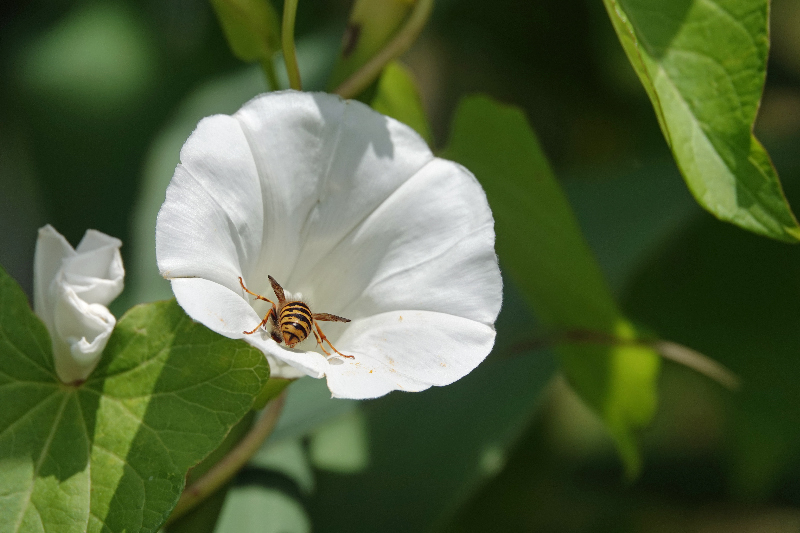
Wasp on a flowering field bindweed. ISO 100, 1/1000 s, 220 mm (600 mm full-frame equivalent). Without a close-up lens, it is not possible to get any closer.
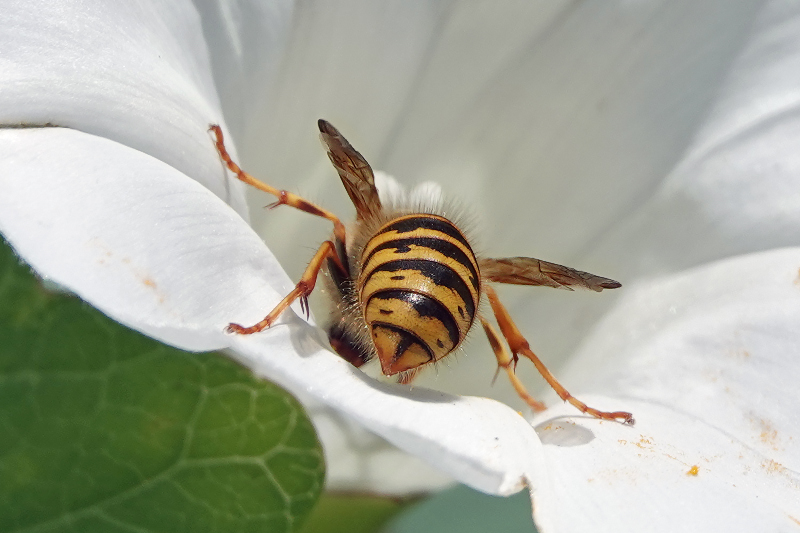
Crop from the image. Sharpness is maintained remarkably well. The crop quality is surprisingly good.
Sample Images: Plant Photography
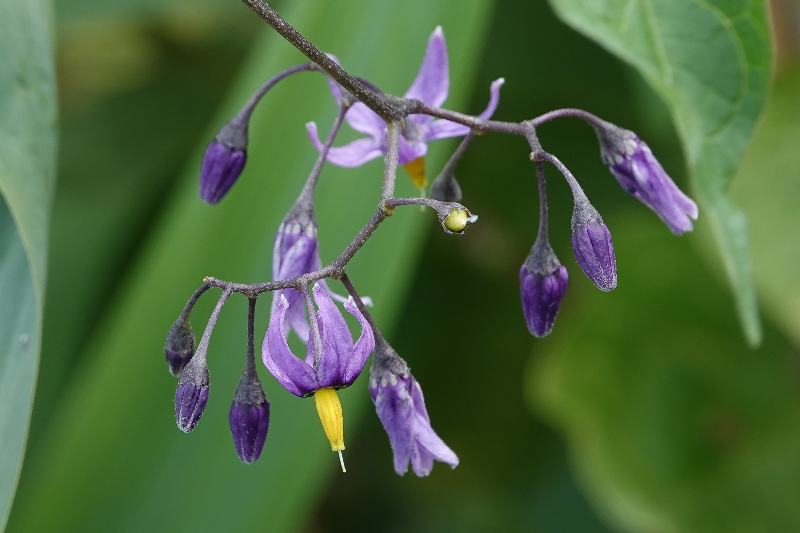
Close-up. Bittersweet nightshade. 220 mm (600 mm full-frame equivalent). Crop.

Field bindweed. Close-up.

Flowering soapwort photographed from approximately 1.5 m away at 190 mm (517 mm full-frame equivalent).
| Index | 1. Zeiss Megazoom + Digital Zoom |
| 2. Autofocus, Shooting with a Tripod, Macro / Plant Photography | |
| 3. Power Supply, Exposure Times, Flicker, JPEG or RAW? Wildlife Photography | |
| 4. Image Quality at Low and High ISO Settings, Evaluation / Photos from Berlin | |
| 5. Boat Photography |