Negative Supply – Scanning Film with a Digital Camera
2026 © Thomas GadeNegative Supply produces tools in California (USA) for scanning slides and negatives with digital cameras. These include film holders, LED panels, and copy stands. The choice of photographic equipment used with them is up to the users, and that determines the resolution at which the originals are scanned. Mirrorless cameras with 24 megapixels and good macro lenses fully resolve most originals in the 24 × 36 mm format and smaller. You don’t need many more pixels for most medium-format images either, though having more can be useful for larger originals.
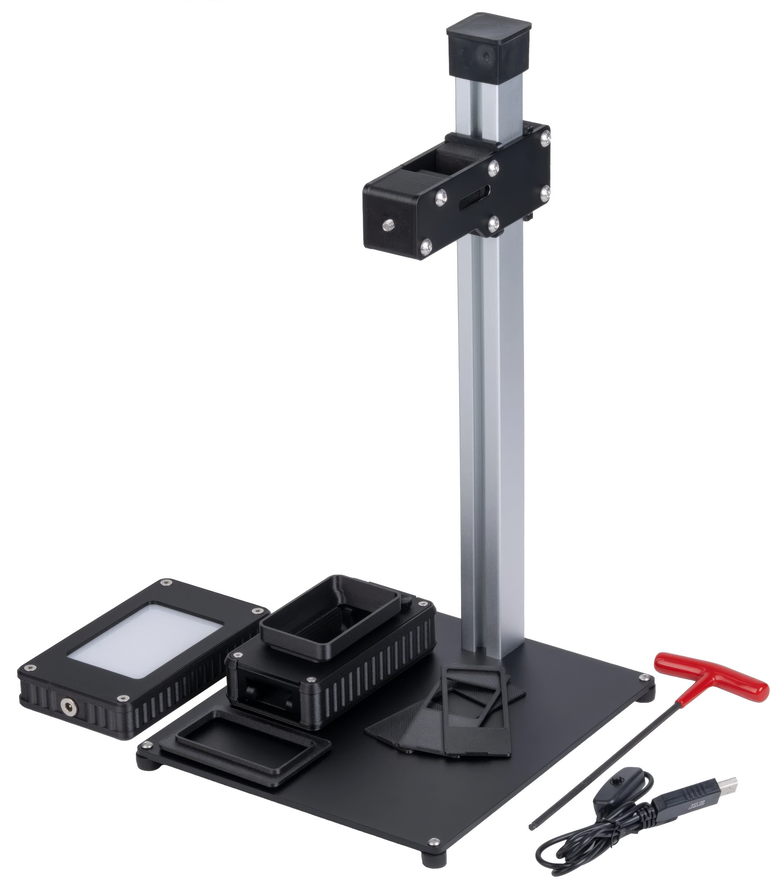
Essential Kit for 35mm Film Scanning (€412 in 2026 at Fotoimpex) / Image source: Negative Supply
Kits with copy stand, film holders, and LED light
The choice of the right components from Negative Supply’s wide range can be tricky because of the variety. Buying a set designed for specific tasks is easier. For example, the Essential Kit for 35 mm Film Scanning includes the components needed to scan slides and negatives on 35 mm film strips. A holder for mounted 35 mm slides, however, must be purchased separately. Mirrorless system cameras with modern macro lenses weighing up to a total of 1.2 kg are easily supported by the “Basic Riser Mini MK3” copy stand.
For around €880, the NEGATIVE SUPPLY Enthusiast Plus Kit for 35mm, 120, and 4x5 Film Scanning includes the longer “Basic Riser XL” copy stand as well as holders for 35 mm film strips, mounted slides, 120/220 roll film, and 4×5 inch sheet film.
These kits include film holders designed for feeding continuous strips of 35 mm or 120/220 film. The strips must therefore be sufficiently long. If the original film has been cut into individual frames, these holders are not suitable.
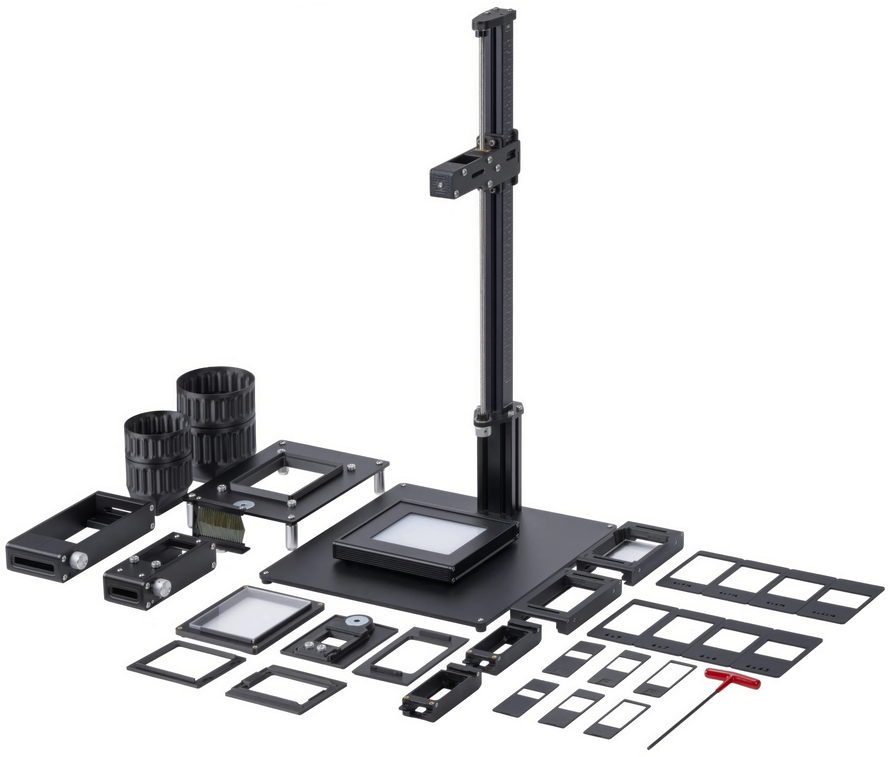
NEGATIVE SUPPLY Pro Kit / Image source: Negative Supply
The “NEGATIVE SUPPLY Pro Kit for 35mm, 120, & 4x5 Film Scanning (2024 version)” is significantly more expensive than the previously mentioned bundles. At €2,380, it may deter most hobby photographers, but for museums, research institutions, or universities, this price is reasonable.
It includes film holders with transport rollers for 35 mm and medium format film, a stage for 4 × 5 inch sheet film, a high-quality LED light source for that format, and a copy stand.
But why is it more expensive than the cheaper kits?
The included Pro Riser MK3 copy stand features a fine-adjustment height mechanism, unlike the more affordable models. On its own, it costs around €925.
The LED light in the Pro Kit evenly illuminates originals up to 4 × 5 inches and has a color rendering index (CRI) of 99. A high CRI value (90–100) ensures accurate color reproduction thanks to an appropriate light spectrum. Color film can already be scanned very well at CRI 95. Higher values are mainly relevant for demanding applications, such as museum work requiring extremely precise color reproduction. Whether a maximum CRI is truly necessary is debatable—but for critical use, a CRI of 99 provides reassurance. Combined with highly even illumination, this justifies the higher cost. The “NEGATIVE SUPPLY 4x5 Light Source Pro 99 CRI” is priced at €780.
4x5 Light Source Pro – 99 CRI
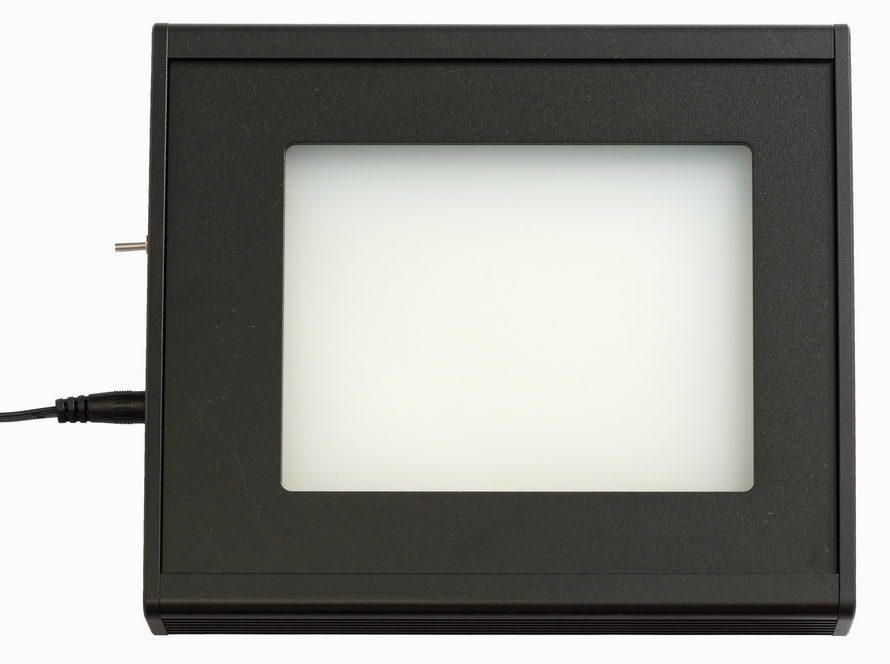
The Negative Supply 4x5 Light Source Pro 99 CRI LED panel was specifically designed to illuminate slides and negatives up to 4 × 5 inches with excellent color accuracy and uniformity. The metal housing feels solid and well-built. With a CRI of 99, color fidelity is theoretically close to the current technical limit. During operation, the panel gradually warms up and should occasionally be turned off to cool down.
€780 is a substantial price for a light source. The more affordable Pro version with “only” 97 CRI costs $549 in the U.S. and €567 in Germany. Negative Supply also offers MK2 models that cover up to 4 × 5 inches and are well built. These are available with 97 CRI for about €203 or with 99 CRI for around €288.
In practice, the differences are usually too small to notice. While 4 × 5 inch coverage defines the benchmark for even illumination, these lights are most commonly used for 35 mm or 120/220 film.
For LED light panels that cost several hundred euros or US dollars, there should be transparent information about the amount of UV light they emit. UV radiation is considered harmful to analog film, which is why archives that place great value on the long-term preservation of original materials rely on accurate data.
There is so-called museum glass that blocks up to 92% of UV light. In principle, you can place such a sheet over the light source to further reduce UV exposure. However, it would be helpful to know whether this is even necessary with the LED panels from Negative Supply.
Missing labeling
Regarding the test unit: The Negative Supply 4x5 Light Source Pro 99 CRI provided by Fotoimpex (the official German importer) had no markings or labels on its housing. For an electrical product sold in the EU, one would at least expect CE marking and manufacturer or importer information.
Pro Mount MK2 with adapters for 35 mm and 120 film holders
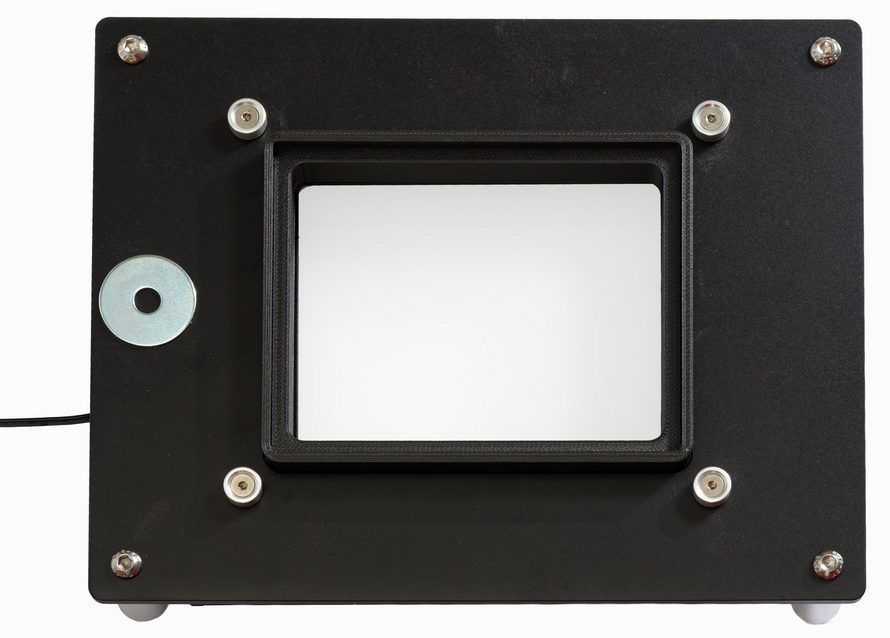
This rectangular metal plate with a central opening is placed over the LED light. It serves as the base for all film holders, which are mounted using adapters. A dust brush can be magnetically attached to the round metal washer on the left side.
Pro Film Carrier 35 MK2 – Film holder for 35 mm film
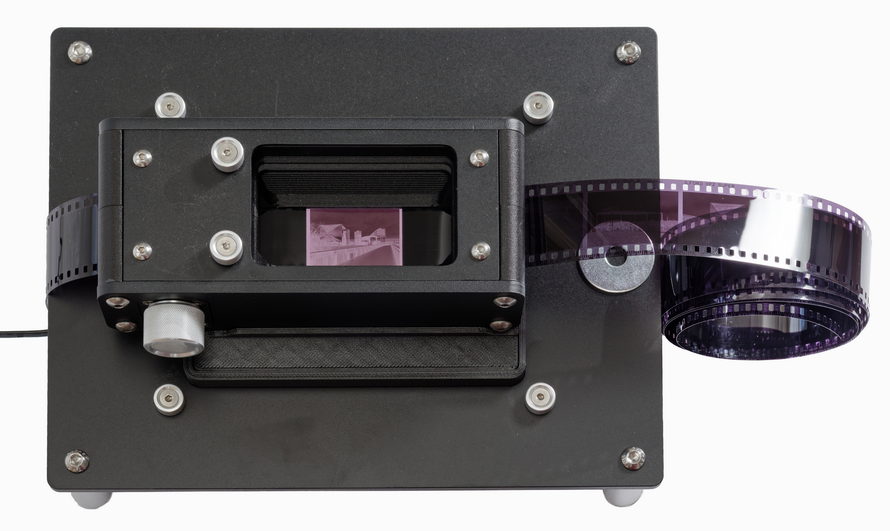
This film holder with a transport dial offers more convenience than manually advancing film strips. It includes three masks: 24 × 36 mm, half-frame, and panorama. An adapter is required to mount it onto the base platform.
This sophisticated film holder is best suited for uncut film that is digitized immediately after development. The NEGATIVE SUPPLY Pro Film Carrier 35 MK2 for 35mm Film Scanning costs about €309 individually. Optional modules for 110 (Pocket), APS, Minox, or 8 mm film are available for €129 each. For larger quantities of such film formats, the investment can be worthwhile.
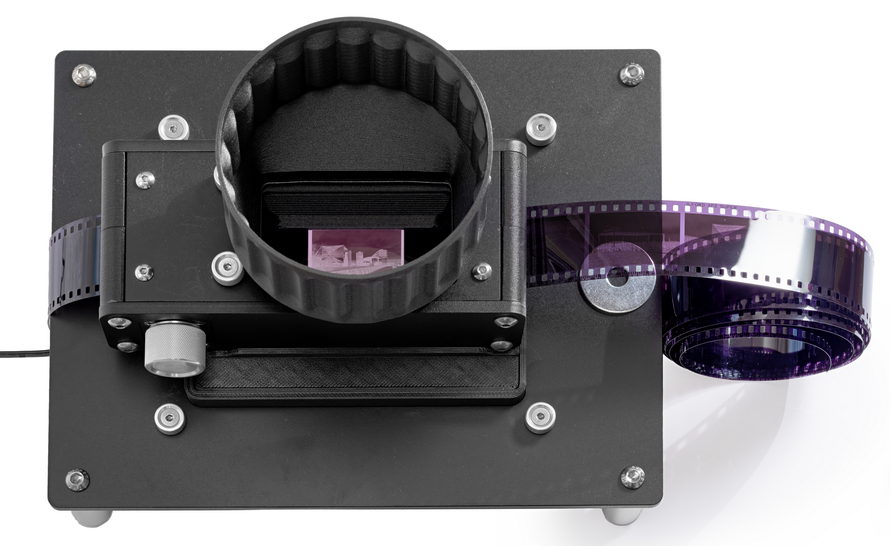
Pro Film Carrier 35 MK2 with 35 mm Film Scanning Hood. A 3D-printed tube shields the space between the film and the lens from ambient light.
Pro Film Carrier 120 MK2 – Film holder for 120 / 220 roll film
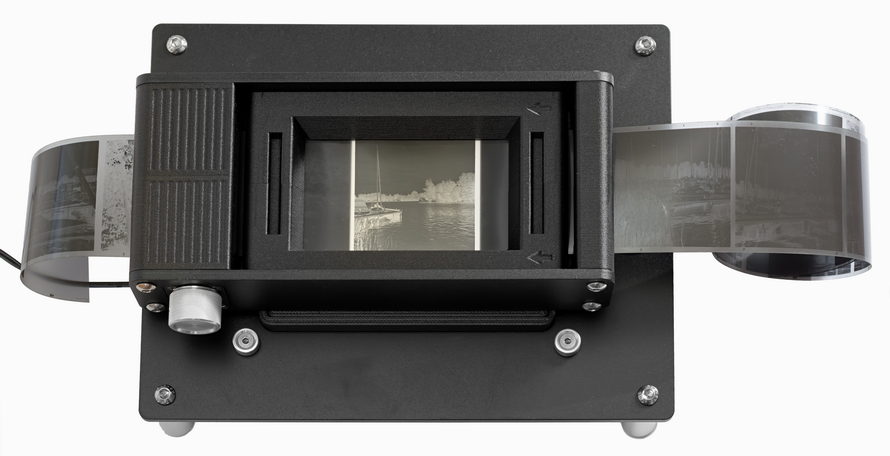
The Pro Film Carrier 120 MK2 is designed for uncut 120/220 roll film. It includes masks for various medium format sizes. The unit is solidly built and features a knob for advancing the film. An adapter (Pro Film Carrier 120 MK3 Adapter for Light Source) is required to mount it on the base platform.
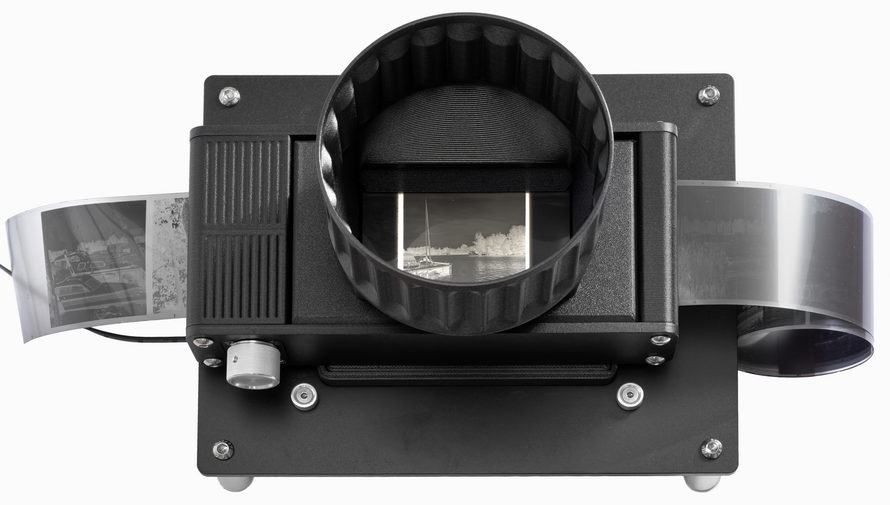
Optional attachable tubes are available for the Pro Film Carrier 120 MK2 to shield the space between the lens and the film from ambient light.
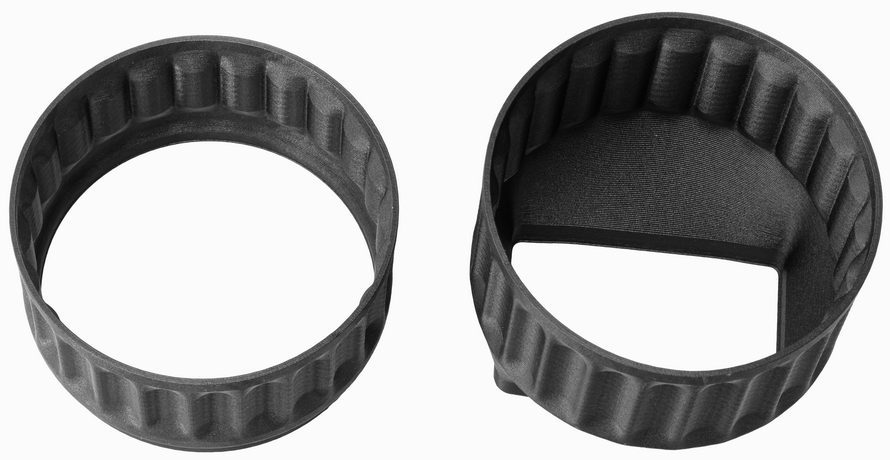
120 Film Scanning Hood MK2
The kit includes stackable 3D-printed tubes designed to reduce stray and ambient light. They work as intended, but their reflective surface is not ideal. A coat of matte black spray paint can help reduce reflections.
Holder for 4x5 inch sheet film
The Pro Kit includes a 4 × 5 inch holder with acrylic plates that keep the film flat. Price: about €100. A version with real glass costs over €400. Both acrylic and glass versions feature a micro-textured surface on one side to prevent Newton rings. Acrylic scratches more easily than glass.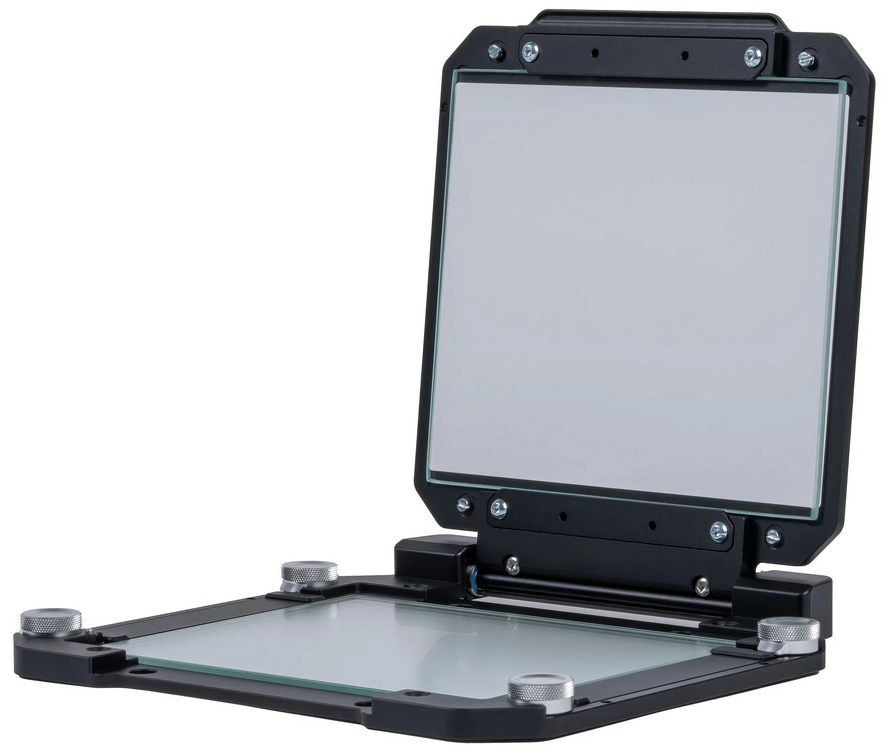
NEGATIVE SUPPLY Pro Film Carrier 4x5 / Image-Source: Negative Supply
If you frequently digitize large quantities of sheet film up to 4 × 5 inches or panoramas on 120/220 film, the NEGATIVE SUPPLY Pro Film Carrier 4x5 (€855.48) is the better choice. Masks for smaller formats are available separately.
But is it worth it?
Sheet film is often digitized using flatbed scanners. While their true resolution may be disappointing for 35 mm film, this is not the case for much larger sheet film formats. It is also unnecessary to scan at maximum DPI. Around 1600 DPI is sufficient, and many scanners still deliver strong effective resolution at that level. Scanning 4 × 5 inch film at 1600 DPI yields roughly 52 megapixels—without Bayer pattern limitations.
Common sheet films have sensitivities between ISO 50 and 400, and large format lenses are not particularly fast. Aperture f/5.6 is often optimal, and shutter speeds typically range from 1 second to 1/500 second, often only up to 1/250 second.
Outside of studio conditions, low ISO values and small apertures can easily result in motion blur—for example with people, animals, plants, or vehicles. As a result, large format images often contain fewer real details than theoretically possible. Therefore, scanning beyond 2000 DPI for 4 × 5 inch film rarely makes practical sense. This should be considered before investing in expensive camera-scanning equipment for sheet film.
Buy everything from Negative Supply?

Negative Supply Pro Riser MK3 (copy stand) with LED light and Pro Film Carrier 35 MK2 scanning 35 mm film using a Pentax K-70 and an SMC Pentax F 2.8 / 50 mm macro lens.
It is certainly convenient to purchase a complete kit. This makes sense for film holders and light sources. However, when it comes to the copy stand, brand loyalty is not necessary—there are alternatives that may better suit your needs.
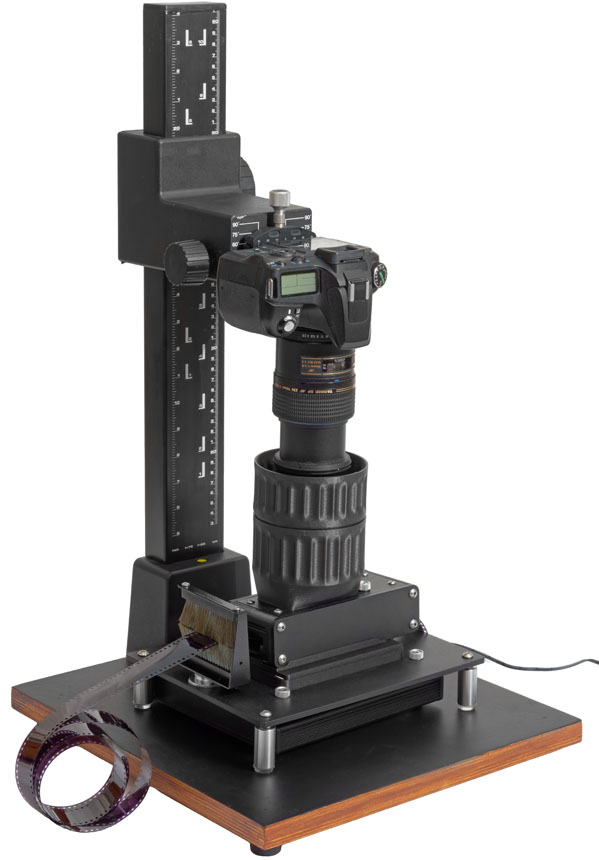
The LED light and matching film holders can also be used effectively with copy stands from other manufacturers. Here, a modified copy stand from Kaiser Fototechnik is used.
continue reading: Review Negative Supply Pro Riser MK3